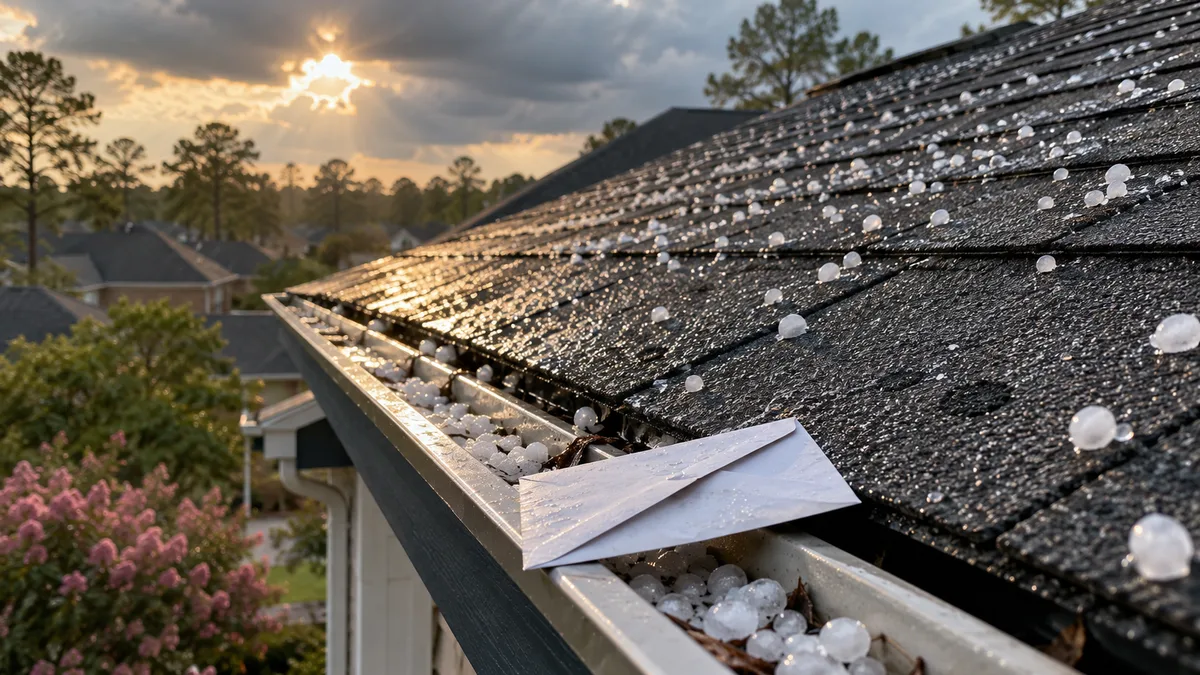
Two hailstorms in three years. After each one, half the subdivision had roofers on ladders and new shingles going up.
This homeowner filed both times. Both times the adjuster came out, found nothing the policy would pay for, and the claim closed at $0.
Then a letter showed up. The "activity" on the account, it said, put the policy at risk of cancellation.
Two claims. Zero dollars paid. And now the policy is in trouble anyway.
Another homeowner the same week had a different version of the problem: a 13-year-old roof, a renewal that jumped to $5,300, and two other quotes that both came in over $5,000.
Short answer: Yes, a denied or $0 claim can count against you. Insurers report claim files that were opened or formally denied to the CLUE database, which keeps up to 7 years of history, and many carriers count every claim you file when they review your policy. Georgia law limits nonrenewal for two or fewer claims in 36 months when the claims weren't your fault, but it doesn't erase the record. The best protection is calling your agent before you file and keeping your roof records current.
Why does a claim that paid nothing still count?
Because the record shows that a claim was made, whether or not money changed hands.
Insurers report to CLUE (the Comprehensive Loss Underwriting Exchange, run by LexisNexis) when they pay a claim, when they open a file for a possible claim, and when they formally deny one. The Tennessee Department of Commerce and Insurance spells this out on its CLUE page. A file that closes at $0 can still sit on your report for years.
Any carrier you apply to can pull that report. It's tied to you and to the property address.
Why would a company care about a claim it didn't pay? Underwriters read claim frequency as a predictor. The Tennessee Department of Commerce and Insurance puts it plainly: insurers use your claims history to decide whether to offer coverage and what to charge, because their studies show a link between past claims and future ones. Two hail claims in three years tells them the house sits where hail hits and the owner files after storms. From their side, the next storm looks like a third claim. You can disagree with that logic and still have to live with it.
What does a warning letter about "claim activity" mean?
Usually it's a heads-up that the carrier is reviewing whether to renew your policy. Take it seriously, and start working on it the day it arrives.
In Georgia, once a homeowners policy has been in force for more than 60 days, the law limits why a carrier can cancel it mid-term. The permitted reasons are nonpayment, fraud or material misrepresentation, a change that substantially increases the hazard, or violating a material term of the policy. Filing claims isn't on that list.
Nonrenewal is where claim history comes in. Georgia law says a carrier can't nonrenew a residential property policy for two or fewer claims against the policy in the past 36 months, as long as those claims weren't caused by the negligent or intentional acts of the insured or someone living in the home. The Georgia Insurance Department's Bulletin 24-EX-2 repeats that rule, and nonrenewal notices have to state the reasons.
So in Georgia, two weather claims in three years should be protected from nonrenewal on that basis alone. A few things that protection doesn't do:
- It doesn't remove the claims from CLUE.
- It doesn't stop a rate increase at renewal.
- A third claim inside 36 months falls outside it.
- It doesn't stop a carrier from nonrenewing for a different reason, like the condition of the roof.
Does a $0 claim count as a "claim" under that Georgia rule? The statute defines a claim as contact with the insurer for the express purpose of seeking payment under the policy. A report of loss or a coverage question doesn't count by itself. If you called and asked them to pay for hail damage, that's a claim, even if they paid nothing.
If you're in Alabama or Tennessee, ask your agent how your carrier handles claim frequency and check with your state insurance department. I'm not going to guess at rules I haven't confirmed for your state.
How do I find out what's on my CLUE report?
Request it from LexisNexis. Under the Fair Credit Reporting Act you're entitled to a free copy.
- Request your report online through LexisNexis or by calling 866-312-8076.
- If something is wrong, dispute it through the LexisNexis Consumer Center at 888-497-0011. They verify it with the insurer that reported it and tell you the result, generally within 30 days.
- You can add a short explanation to an item, and it appears on future reports.
If you only called to ask a question and a claim shows up anyway, read I called to ask a question. They opened a claim. Now what? It walks through disputing a claim you never filed.
Why did my renewal jump on an older roof?
Roof age and condition are among the biggest things a carrier looks at on a home in hail country. As a roof gets older, many carriers charge more, raise the wind and hail deductible, settle roof claims at actual cash value instead of replacement cost, or decline to renew. Where those lines fall varies by carrier.
Some forms put the roof's age right into the payout. On some homeowners forms, if your declarations show "scheduled roof payment," roof damage is paid at a percentage tied to the roof's age and material. For a standard composition shingle roof, that's 100% when it's new and 56.7% at 13 years old, and it keeps dropping each year. Other carriers use different schedules or plain actual cash value, so check how yours settles the roof before a storm.
Replacement cost on a roof is getting harder to keep. A new roof can usually qualify for it, but most carriers won't offer replacement cost on a roof older than about 10 years. What you have today often depends on how long you've had the policy, so look before you assume.
A 13-year-old roof with two recent hail claims is a hard file to place. That's how you end up with three quotes over $5,000.
If you're buying a house and the roof is older, read buying a house with an old roof in Georgia before your inspection period ends.
Got a new roof? Send your agent the certificate of completion
If your roof was replaced, make sure your policy knows it. Send your agent the roofer's certificate of completion or final invoice showing the date, the material and the address.
An agent shared this tip online recently, and hundreds of homeowners said they had no idea. After a storm claim pays for a new roof, the claims side of a carrier doesn't always update the underwriting record. The policy can keep rating the old roof for years. You're paying for a 15-year-old roof while a 2-year-old one sits on the house.
The same goes for a roof you paid for yourself. Updating the roof year can change your premium, your deductible options and how a future roof claim is settled.
Keep a copy of that paperwork with your policy. You'll want it when you shop, and you'll want it again when you sell.
Alabama homeowners: ask about a FORTIFIED roof
If you live in Alabama, a FORTIFIED roof can lower the wind portion of your premium, and the state may help pay for it.
Alabama law (Sections 27-31D-1 to 27-31D-5 of the Alabama Code) requires property insurers to include premium discounts for homes built to FORTIFIED standards from the Insurance Institute for Business and Home Safety (IBHS), applied to the wind portion of the premium. The requirement applies statewide, to new homes built to FORTIFIED standards and to existing homes retrofitted to them.
The state's Strengthen Alabama Homes program offers grants that pay 100% of the mitigation cost up to $10,000, and the work has to reach the FORTIFIED Roof or Silver standard. Grant rounds and rules change, so check the Alabama Department of Insurance site for current openings.
In Georgia and Tennessee, many carriers give a discount for impact-resistant shingles. If you're replacing the roof anyway, ask your agent what that discount would be before you pick shingles.
Should I file a hail claim when a roofer says I have damage?
Get the facts first, then decide. A free roof inspection after a storm usually comes from a roofer who gets the job if a claim is approved.
Your neighbor's approved claim doesn't decide yours. Each roof is inspected on its own: its age, its material, the damage on it, and your policy wording. Read your roof coverage before a storm.
Some forms don't pay for hail dents on metal roofing, metal gutters and downspouts, or metal parts of windows and doors unless the hail makes an actual hole.
Then check the deductible. Many homeowners policies in Georgia, Alabama and Tennessee carry a separate wind or hail deductible, and it may be a percentage of your dwelling limit. Others don't. Some base forms use the regular deductible for wind and hail and save a percentage deductible for named hurricanes. Some policies let you choose a split deductible, with a separate amount for wind and hail. Endorsements can change that, so check your declarations page.
Example: a $400,000 dwelling limit with a 1% wind and hail deductible means a $4,000 deductible. A roofer's $6,500 repair estimate nets you $2,500, plus a claim on your record for years. A full $22,000 replacement nets you $18,000. Those are very different decisions.
Before you file:
- Call your agent with a hypothetical. Don't call the claims line to ask.
- Ask for your wind and hail deductible in dollars, not percent.
- Get a written estimate with photos of the actual damage.
- Run the math. I laid out how in should you file a claim or pay out of pocket.
If the damage is real and large, file. That's what the policy is for.
Don't sit on it forever, either. Some policies set a deadline for reporting wind or hail damage. Some forms require notice within 365 days of the storm.
How to document your roof before storm season
Do this once a year, in the spring before hail season, and again after any roof work.
- Dated photos of every slope from the ground, plus closeups of the shingles if a roofer is up there anyway. Store them in the cloud with the date.
- Your roof paperwork: certificate of completion, invoice, permit and warranty.
- Gutters, vents and flashing, since hail damage often shows up there first.
- After a storm, photos of hailstones next to a coin or ruler, and the date and time.
Before-and-after photos give you and the adjuster something concrete to compare. They also help you decide whether there's anything worth filing at all.
What to do if you get a claim-activity warning letter
- Read the reason. Is it claim frequency, roof age, a condition the inspector flagged, or something else?
- Pull your CLUE report. Make sure what's on it is accurate. Dispute anything that isn't.
- Call your agent. Ask whether the carrier is likely to nonrenew and whether anything you can fix would change that, like proof of a new roof.
- Start shopping early. Give yourself 45 to 60 days before renewal. A rushed search narrows your choices.
- Hold off on small claims. Another small claim now can turn a warning into a nonrenewal.
- Never let the policy lapse. If you have a mortgage, a lapse can lead the lender to buy coverage for you and add it to your payment. That coverage usually costs more, and it's written to protect the lender's loan on the house. Your belongings and your liability usually aren't part of it.
If your carrier paid a claim and then tried to drop you, this post covers what to do.
What to check on your policy
- The roof year your carrier has on file.
- Your wind and hail deductible, in dollars.
- Whether your roof is settled at replacement cost, actual cash value or a schedule based on its age.
- Any roof exclusion or roof settlement endorsement.
- Your dwelling limit against today's rebuild cost. The rebuild cost calculator is a good first check.
Let me look before you file
I do a free Claim Ready Coverage Check. Send me your declarations page and I'll go through every line of it: your roof year, your hail deductible, how your roof is settled, and whether your carrier has your house right. We'll also talk through whether a claim you're thinking about is worth filing before anything gets reported.
If you already got the letter, send that too and I'll tell you what I'd do next.
Email michael@ins.insure, call 678-578-7009, or request a quote here. We write home, auto and umbrella in Georgia, Alabama and Tennessee.
Frequently asked questions
Does a denied insurance claim go on your record?
It can. Insurers report claims they pay, files they open for a possible claim, and claims they formally deny to the CLUE database, which generally keeps up to 7 years of history. A claim that closed at $0 can still appear.
Can my insurance company drop me for claims that weren't paid?
Carriers look at how often you file, so unpaid claims can still factor into a renewal decision. In Georgia, a carrier can't nonrenew a homeowners policy for two or fewer claims in 36 months that weren't caused by the negligent or intentional acts of the insured or a household member. Ask your agent how your carrier handles it in Alabama and Tennessee.
Can a Georgia insurer cancel my homeowners policy in the middle of the term for filing claims?
After a Georgia policy has been in force more than 60 days, mid-term cancellation is limited to reasons such as nonpayment, fraud or material misrepresentation, a substantial increase in hazard, or violation of a material policy term. Claim history usually comes up at renewal instead.
How do I get my CLUE report?
You're entitled to a free copy from LexisNexis under the Fair Credit Reporting Act. You can request it online or by calling 866-312-8076, and dispute errors at 888-497-0011.
Should I tell my insurance company I got a new roof?
Yes. Send your agent the roofer's certificate of completion or final invoice with the date and material. The policy may still be rating your old roof, and updating it can change your premium, deductible options and how roof claims are settled.
Does Alabama require a discount for a FORTIFIED roof?
Yes. Alabama law requires property insurers to include premium discounts for FORTIFIED construction, applied to the wind portion of the premium. The Strengthen Alabama Homes program offers grants of up to $10,000 toward a FORTIFIED roof.
Should I call my insurance company to ask if hail damage is covered?
Call your agent first with a hypothetical question. A call to the claims line can open a claim file that may be reported to CLUE even if nothing is paid.
Sources
- Tennessee Department of Commerce and Insurance: C.L.U.E. (Comprehensive Loss Underwriting Exchange): Explains that insurers report paid claims, files opened for a possible claim and formal denials; up to seven years of history; free report at 866-312-8076; disputes at 888-497-0011 answered within 30 days; consumers can add an explanation. Also says insurers use claims history to decide whether to offer coverage and what to charge, and that insurer studies show a relationship between past claims and future claims.
- Georgia Code section 33-24-46, cancellation or nonrenewal of certain property insurance policies (FindLaw copy): Defines a claim against a policy, says a report of loss or coverage question does not by itself establish one, limits cancellation after 60 days to listed reasons, and bars nonrenewal for two or fewer claims in 36 months not attributable to negligent or intentional acts.
- Georgia Office of Insurance and Safety Fire Commissioner: Bulletin 24-EX-2, nonrenewal requirements and prohibitions: Lists two or fewer claims in the preceding 36 months, not attributable to the insured's negligent or intentional acts, as a prohibited reason for nonrenewal.
- Ala. Code 27-31D-1 and 27-31D-2, premium discounts for FORTIFIED construction (Justia, 2025 Code of Alabama): Insurers shall provide a premium discount or rate reduction for homes built or retrofitted to FORTIFIED standards, applied to the wind portion of the premium (or the total premium if wind isn't separated). Applies to insurable property statewide.
- Alabama Department of Insurance: Strengthen Alabama Homes: Grants pay 100% of mitigation cost up to $10,000; work must reach the IBHS FORTIFIED Roof or Silver standard; FORTIFIED homes receive wind premium discounts mandated under state law.
- CFPB: what can I do if my servicer is charging me for force-placed homeowners insurance?: Force-placed insurance is usually more expensive than a policy you find yourself, and in many instances protects only the lender.