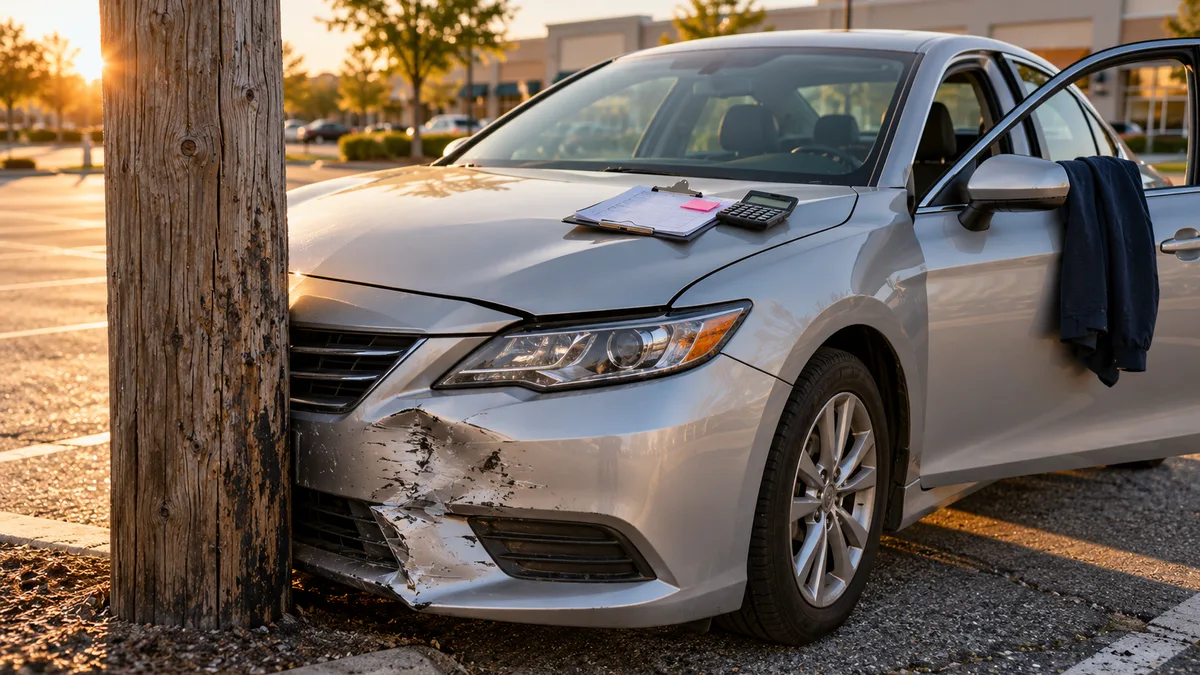
A driver clips a pole on the way out of a parking lot. Single car, nobody else involved, nobody hurt. The body shop estimate comes back at $2,445.
The collision deductible is $250. The policy covers two cars and runs about $198 a month.
So the question: file and collect $2,195, or pay the shop and keep the claim off the record?
The same week, a different driver rear-ended someone at a light. About $5,000 in damage, and the police report put the fault on them. Their question was simpler and scarier: what happens to my rate now?
Both questions come down to the same habit. Do the math before you call the claims line.
Short answer: File when the check is big compared with what the surcharge will cost you over the years it sticks, or any time another person, another car or someone else's property is involved. Pay it yourself when the damage is small, only your own car or house is hurt, and the payout barely beats the extra premium you'd pay. If you hit someone else's car, report it to your carrier. That part isn't optional.
How much will my insurance go up after an at-fault accident?
There's no single number. It depends on your carrier's rating plan, your state, your driving record and how big the claim was.
What's fairly consistent is the time frame. An at-fault accident usually affects your rate for about 3 years, sometimes up to 5, depending on the carrier. The claim itself stays in insurance databases longer. The CLUE database (Comprehensive Loss Underwriting Exchange) generally holds up to 7 years of auto and home claims history, and any company you apply to can see it.
So when you decide whether to file, you're comparing one check today against several years of higher premium. You can work it out in 5 minutes.
How do I figure out whether to file a claim or pay myself?
Take the payout you'd get, subtract what the claim will cost you in extra premium over the years it counts. If the number is comfortably positive, file. If it's close or negative, pay the shop.
Here are the steps:
- Find your payout. Repair estimate minus your deductible.
- Find your annual premium. It's on your declarations page.
- Estimate the surcharge. Ask your agent what an at-fault claim of this size does on your carrier's plan. If you can't get a number, run the math at a few percentages to see where the line falls.
- Multiply by the years it sticks. Use 3 years unless your agent tells you otherwise.
- Add anything you'd lose. Claims-free or accident-free discounts can disappear after a claim, so count those too.
- Compare. Payout minus total extra premium.
Example: the $2,445 pole hit
Example only. The surcharge percentages below are assumptions to show the method, not a quote from any carrier.
- Repair estimate: $2,445
- Deductible: $250
- Payout if you file: $2,195
- Annual premium: $198 x 12 = $2,376
| Assumed increase | Extra per year | Extra over 3 years | Payout minus extra premium |
|---|---|---|---|
| 15% | $356 | $1,069 | +$1,126 (filing wins) |
| 25% | $594 | $1,782 | +$413 (close call) |
| 40% | $950 | $2,851 | -$656 (paying yourself wins) |
Look at how thin that middle row is. At a 25% increase you'd file a claim, carry it on your record for years, and come out about $400 ahead. Lose a claims-free discount on top of that and the gain can disappear.
Now run a bigger claim through the same table. Say the estimate is $9,000. The payout is $8,750, and even the 40% row only costs $2,851 over 3 years. File that one.
That's the pattern. Small claims are where people lose money by filing. Big claims are what insurance is for.
What about accident forgiveness?
Some policies forgive your first at-fault accident, so your rate doesn't go up for it. If you have it, the math above changes a lot in favor of filing.
Don't assume you have it. It's usually an endorsement or a program with its own rules: how long you've been with the carrier, how clean your record is, whether it covers every driver on the policy. It's on your declarations page or your agent can tell you in a couple of minutes.
One more thing to know. Forgiveness generally protects your rate with your current carrier. The claim can still show up on your CLUE report, and a different company quoting you later can see it. Ask your agent how your carrier handles that.
I rear-ended someone. Do I have to report it to my insurance?
Yes. When another car, another person or someone else's property is involved, report it to your carrier promptly, even if you're thinking about paying for it yourself.
The standard personal auto policy says it plainly: the insurer must be notified promptly of how, when and where the accident happened, including the names and addresses of anyone injured and any witnesses. If you sit on it and that delay hurts the company's ability to handle the claim, it can affect your coverage.
Here's why paying quietly goes wrong:
- The other driver can file against you anyway. They don't need your permission to call your carrier and open a liability claim. If that happens weeks later, your carrier is hearing about it from the other side first.
- Injuries show up late. A sore neck at the scene can turn into physical therapy bills a month later. A $5,000 fender repair you paid in cash doesn't protect you from a bodily injury claim.
- You don't know what the repair really costs. Rear bumper damage on a newer car often hides sensors, brackets and frame work. The first estimate is rarely the last one.
- Your policy has a rule about it. Auto policies generally say an insured shouldn't voluntarily make payments or take on obligations to other people, other than first aid. If you pay the other driver directly and it later turns into a bigger claim, the carrier can point to that clause.
So for the driver with the $5,000 rear-end: report it. Expect the at-fault accident to affect your rate for about 3 years, possibly longer depending on the carrier. Ask your agent whether you have accident forgiveness and whether any discounts change. Then use those years to keep the record clean.
If you're the one who got hit, the other driver's liability coverage should pay for your car. If they're uninsured or their carrier stalls, that's where your own uninsured motorist coverage and collision come in. I wrote about the coverage most people reject here.
When is filing a claim clearly the right call?
File, or at least report, in these situations:
- Anyone is hurt. Yours, theirs, a passenger, a pedestrian. Always.
- Someone else's car or property is damaged. A fence, a mailbox, a parked car. Liability claims belong with your carrier.
- The damage is large. When the payout is several times bigger than a few years of surcharge, file.
- The car may be a total loss. Your carrier handles the valuation. Don't try to self-fund that.
- You weren't at fault. The other side's insurance should pay. In Georgia, the law says an insurer can't surcharge your auto premium or cancel your policy because you were in a multivehicle accident you didn't cause (O.C.G.A. 33-9-40). A Georgia court has held that the rule covers cancellation, not nonrenewal. Outside Georgia, how a not-at-fault claim is treated varies by company.
- A police report names you at fault. The other party has paperwork and a reason to call your carrier. Get ahead of it.
Does the same math work for homeowners claims?
Mostly. Two things change: home deductibles are bigger, and a home claim can cost you the policy at renewal, on top of any rate increase.
Home deductibles of $1,000, $2,500 or more are common now, and some policies carry a separate wind or hail deductible that's a percentage of your dwelling limit. That leaves less room between the deductible and the damage on a small claim.
Example: a storm takes out a section of fence and a run of gutter. The estimate is $4,100 and the deductible is $2,500. Filing gets you $1,600 and puts a claim on your home's history for up to 7 years. Your carrier now has one more claim to count at renewal. Unless something else is wrong with the house, that's a trade I'd think hard about.
Georgia gives homeowners some protection here. State law says an insurer can't nonrenew a residential property policy for two or fewer claims in the past 36 months, as long as those claims weren't caused by the negligent or intentional acts of the insured or someone living in the home. A Georgia Insurance Department bulletin repeats that rule.
That protection has limits. It's about nonrenewal. It doesn't stop a rate increase, it doesn't remove the claim from CLUE, and a third claim falls outside it. If you're in Alabama or Tennessee, ask your agent how your carrier handles claim frequency, because the rules and practices differ.
One more home rule to know. Your homeowners policy says you can't voluntarily make payments or take on obligations to other people at the insurer's expense. If a guest trips on your steps, get them help, then call your agent. Don't promise to cover their bills on the policy's behalf.
If a home claim does go through and the carrier pays, read this before you cash the check: why your mortgage company is named on it. And if you've been paid and then got a nonrenewal notice anyway, this post walks through it.
Can I ask my agent whether something is covered without opening a claim?
Yes, and you should. Call your agent with a hypothetical question before you call the claims line.
A claims line exists to take claims. Once a claim file is opened, it can be reported to CLUE even if it closes at $0. Georgia law says a report of loss or a question about coverage doesn't by itself establish a claim against a policy, and LexisNexis advises insurers not to report a simple coverage question. In practice, people still end up with files they never asked for. I wrote about one homeowner it happened to in I called to ask a question. They opened a claim.
If you do have to call the carrier with a question, say this first and write down who you spoke with:
I'm not reporting a loss and I'm not requesting a claim. I have a coverage question. Please confirm no claim file is being opened from this call.
What to check on your policy before you ever need this
- Collision and comprehensive deductibles. A $250 deductible sounds nice, but it costs more premium and tempts you into small claims. Many people are better off at $500 or $1,000 with the savings set aside.
- Accident forgiveness. Do you have it, who does it cover, and what are the conditions?
- Claims-free or accident-free discounts. Know which ones you have and what a claim would do to them.
- Your home deductibles. All of them. Look for a separate wind or hail deductible, or a hurricane deductible, and whether it's a percentage.
- Liability limits. If you're paying out of pocket to protect a rate, make sure the coverage that protects your savings is high enough. The liability calculator gives you a starting point.
What to do after a small accident or small home loss, step by step
- Handle safety first. Check on everyone, call police when someone's hurt or the law requires it, and exchange information.
- Take photos. Damage, the scene, the other car's plate, the road or the house. Date them.
- Protect the property. Tarp a roof, shut off water, move the car somewhere safe. Keep receipts. Your policy expects you to prevent more damage.
- Get one real estimate. You can't decide anything without a number.
- Call your agent with a hypothetical. Ask what a claim of that size does to your rate and discounts on your carrier's plan.
- Run the math. Payout minus 3 years of extra premium and lost discounts.
- Decide quickly. Policies require prompt notice. If anyone else is involved, report it now.
- If you pay yourself, pay the shop directly and keep the invoice and photos in case the damage turns out bigger than the estimate.
Get the numbers before you need them
I do a free Claim Ready Coverage Check. Send me your declarations pages for your home and cars and I'll go through every line of them: your deductibles, your liability limits, whether you have accident forgiveness, and where a small claim would cost you more than it pays.
Then when something happens, you call me first and we run the math together before anything gets filed.
Email your dec pages to michael@ins.insure, call 678-578-7009, or request a quote here. We write home, auto and umbrella in Georgia, Alabama and Tennessee.
Frequently asked questions
Should I file a claim for a small car accident?
If only your car is damaged and nobody is hurt, compare the payout (estimate minus deductible) with the extra premium you'd pay over about 3 years. If the gain is small or negative, paying yourself often costs less. If another car, person or property is involved, report it to your carrier.
How much does insurance go up after an at-fault accident?
It depends on the carrier, the state, your record and the size of the claim, so there's no single percentage. Ask your agent what a claim of that size does on your carrier's rating plan. An at-fault accident usually affects your rate for about 3 years, sometimes longer.
How long does a claim stay on my insurance record?
Claims generally stay on your CLUE report for up to 7 years. The rate surcharge for an at-fault auto accident usually lasts about 3 years, though it varies by carrier.
Do I have to report an accident to my insurance if I pay for it myself?
If another driver, person or property is involved, report it promptly. The standard auto policy requires prompt notice, and the other party can file a claim against you whether you report it or not. A late report can create coverage problems.
Does a claim count against me if I wasn't at fault?
Carriers usually treat not-at-fault claims differently from at-fault claims, and the other driver's liability coverage should pay for your damage. In Georgia, O.C.G.A. 33-9-40 bars an insurer from surcharging or canceling an auto policy because of a multivehicle accident you didn't cause. Elsewhere, it depends on the carrier, so ask your agent.
Will asking my insurance company a question open a claim?
It shouldn't. Georgia law says a coverage question doesn't by itself establish a claim, and LexisNexis advises insurers not to report simple questions. To be safe, ask your agent instead of the claims line, and say up front that you are not reporting a loss.
Can a homeowners claim get my policy nonrenewed?
It can. In Georgia, a carrier can't nonrenew for two or fewer claims in 36 months that weren't caused by the negligent or intentional acts of the insured or a household member. That protection doesn't stop rate increases, and a third claim falls outside it.
Sources
- Tennessee Department of Commerce and Insurance: C.L.U.E. (Comprehensive Loss Underwriting Exchange): A regulator's explanation of CLUE: up to seven years of personal auto and property claims history, insurers report files opened for a possible claim and formal denials, and LexisNexis advises insurers not to report a simple coverage question.
- Insurance.com: how long do accidents stay on your insurance?: Says an at-fault accident affects rates for an average of three years, three to five years in general, while the record can stay in insurance databases for up to seven years.
- PropertyCasualty360: personal auto policy, Parts E and F: Quotes the standard personal auto policy's duty to notify the insurer promptly of how, when and where an accident happened, and explains that the insurer can deny coverage for a failure to comply only when it is prejudiced.
- ISO Homeowners 3 Special Form HO 00 03 05 11, copy hosted by the Maine Bureau of Insurance: Standard form duties after loss (prompt notice, protect the property) and the Section II condition that an insured may not voluntarily make payments or assume obligations except at their own cost. Carrier forms can differ.
- Georgia Code section 33-24-46, cancellation or nonrenewal of certain property insurance policies (FindLaw copy): Says a report of loss or a question about coverage does not by itself establish a claim, and bars nonrenewal for two or fewer claims in 36 months that are not attributable to negligent or intentional acts of the insured or household members.
- Georgia Office of Insurance and Safety Fire Commissioner: Bulletin 24-EX-2, nonrenewal requirements and prohibitions: Lists two or fewer claims in the preceding 36 months, not attributable to the insured's negligent or intentional acts, as a prohibited reason for nonrenewal.
- O.C.G.A. 33-9-40, no surcharge or cancellation for not-at-fault multivehicle accidents (Justia, 2025 Code of Georgia): No insurer shall surcharge the premium or cancel a motor vehicle policy because of the insured's involvement in a multivehicle accident when the insured was not at fault. Annotation: a 1989 Georgia Court of Appeals decision held that 'cancel' does not include nonrenewal.