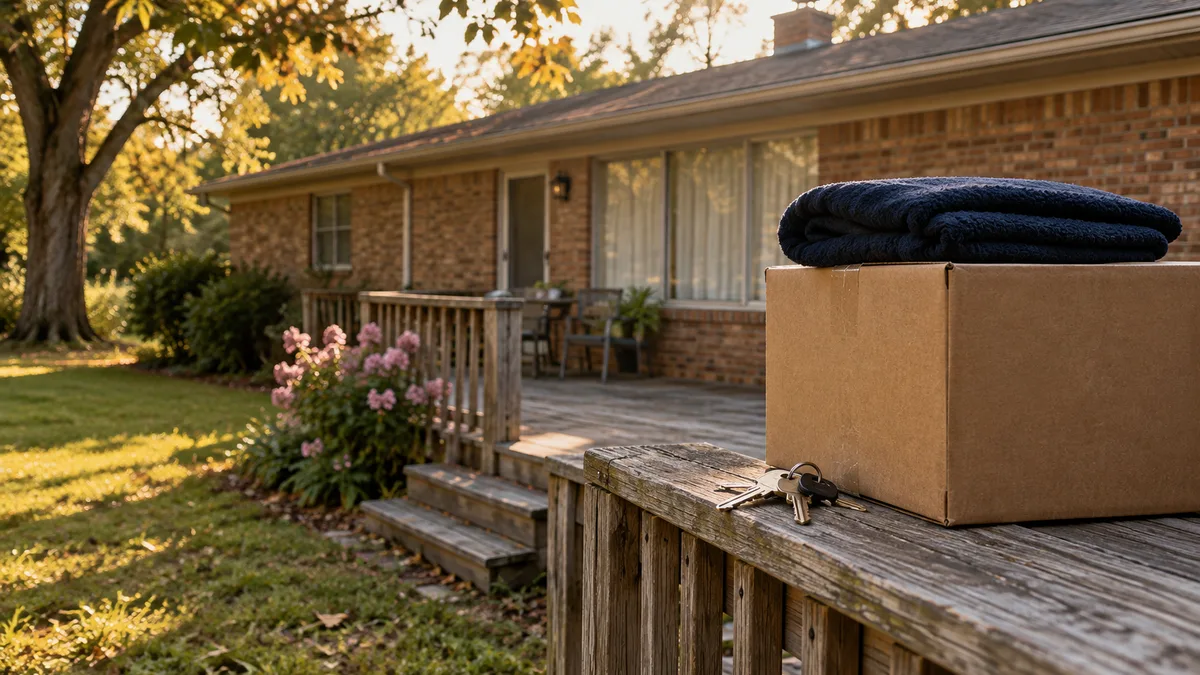
Both parents are gone, close together. The oldest kid is now in charge of the family house, along with everything else. Someone tells them the homeowners policy has to be moved into the name of the estate until probate is finished. The insurance company wants to send an inspector. The deck out back is rough, and they're afraid the inspection will cost them the policy.
Two other versions of the same problem came up the same week. One person inherited their dad's house in the deep South and found out there was no homeowners policy on it at all. Another family has been living rent-free in a relative's house for years and wants to know if they can insure a house when their name isn't on the deed.
All three are the same question underneath: who insures a house when the person who owned it is gone, or isn't the one living there?
Short answer: When the named insured dies, a standard homeowners policy keeps covering the house for a while. It covers the deceased owner's legal representative (the executor or administrator) for that house and property, and it keeps covering household members who lived there while they still live there. Treat that as a bridge. Call the agent within days, get the estate shown on the policy, say whether the house will sit empty, and expect to move to a vacant or dwelling policy if nobody will live there for more than a month or two. Don't wait on this. If the carrier learns after a loss that the house was sitting empty, the claim can be denied. If you live in a house you don't own, you insure your belongings and your liability with a renters policy, and the owner insures the building.
What happens to homeowners insurance when the owner dies?
The policy keeps going after the date of death. On the standard homeowners form, the coverage shifts to the people who are now responsible for the house.
The standard HO-3 form has a condition titled "Death." When a person named on the declarations page dies (or their spouse, if they lived in the same household), the form says the company insures the legal representative of the deceased, "but only with respect to the premises and property of the deceased covered under the policy at the time of death." It also keeps two groups of people insured:
- A household member who was an insured at the time of death, while that person still lives at the residence premises.
- Until a legal representative is appointed, the person who has proper temporary custody of the property, for that property.
In plain terms:
- The house and the contents are still covered for now.
- The executor or administrator steps into the owner's place for that house and that property once the court appoints them.
- A surviving spouse or adult child who lived in the house is still covered while they live there.
- Before anyone is appointed, the family member checking on the house and holding the keys is covered as the person with temporary custody.
Carrier forms differ from the standard wording, so read the "Death" condition in your own policy or ask your agent to read it with you.
The bridge has limits. It lasts until the policy expires, gets canceled, or stops getting paid. That last one catches families more than anything else. If the premium came out of the deceased person's checking account by autopay, the bank may freeze that account when it learns of the death. The next payment bounces, a cancellation notice goes to a mailbox nobody is checking, and the policy ends for nonpayment. If there's a mortgage with an escrow account, the mortgage servicer usually keeps paying the premium, but confirm that too.
Does the homeowners policy have to be in the estate's name?
Usually, yes, at some point. Most carriers want the policy to show who owns the house now, and during probate that's normally the estate, with the executor or administrator as the contact.
That's what the person in our first story was told, and it's a reasonable request. The policy is supposed to cover the person with a financial stake in the house. If the named insured is deceased and nobody updates the policy, fix it before there's a claim.
How title passes after death depends on how the deed was written and on the will. Some houses pass outside probate, for example when a surviving spouse owned it jointly with a right of survivorship. That's a probate attorney's question. Your agent's job is to make the policy match whatever the attorney tells you.
When you call, have this ready:
- A copy of the death certificate.
- The name and phone number of the person handling the estate.
- Letters testamentary or letters of administration, once the probate court issues them.
- A mailing address where someone actually reads the mail.
- Who lives in the house right now, if anyone, and since when.
- The plan: keep it, sell it, rent it, or move a family member in.
The plan matters most. A house with a family member living in it, a house sitting empty while it's listed for sale, and a house that's about to be rented are three different risks, and they usually go on different policies.
What changes when an inherited house sits empty?
An empty house is a different risk, and a standard homeowners policy treats it differently. Coverage for some losses drops away after 30 to 60 days of vacancy, depending on the form, and the policy itself was written for a house someone lives in.
On the standard HO-3 form, two vacancy rules apply to the dwelling:
- Vandalism and malicious mischief is not covered if the dwelling has been vacant for more than 60 consecutive days immediately before the loss.
- Glass breakage on the residence premises is not covered if the dwelling has been vacant for more than 60 consecutive days immediately before the loss, unless the breakage comes from earth movement.
Some forms are stricter on timing and define vacant differently. On some homeowners forms, vandalism and theft aren't covered once the house has been vacant more than 30 days, and arson isn't covered after more than 60 consecutive days vacant. That form counts a house as vacant when nobody is living there and most of the belongings have been removed. A house still full of Mom's furniture may not be vacant yet under that wording, and clearing it out to sell can start the clock. Read the vacancy wording in your own policy, or have your agent read it to you.
There's a bigger issue behind those two. A homeowners policy covers the "residence premises," which the standard form defines as the dwelling where you reside. Once the owner has died and nobody lives there, the house no longer fits that description. Many carriers will keep the policy in place for a short time while the estate gets organized. Past that, expect them to want the house moved to a policy written for homes the owner doesn't live in.
Empty houses also have a practical problem. Nobody's there to notice a slow drip under the sink, a running toilet, or a supply line that let go. A leak that would be a $3,000 repair if someone saw it on day one can turn into a $40,000 tear-out after three weeks. If water is the thing that keeps you up at night, read our posts on water heater leaks and slow plumbing leaks.
Freezing is the other winter risk. Standard homeowners forms generally exclude damage from frozen pipes unless you used reasonable care to keep the heat on or shut off the water and drained the system. In an empty house in January, that wording matters. Ask your agent to read you the freezing language in your actual policy.
Taking care of an empty house
- Keep the power on and the heat set to a steady temperature through the winter.
- Shut off the main water valve when nobody's there, unless a fire sprinkler system or a boiler depends on it. Ask a plumber if you're not sure.
- Visit at least once a week. Write down the date and take a few photos each time.
- Stop or forward the mail and keep the yard cut so the house doesn't look abandoned.
- Put a couple of lights on timers and change the locks if you don't know who has keys.
- Call your agent the day the house becomes empty, and again if the plan changes.
What is a vacant home or dwelling policy?
A dwelling policy insures a house the owner doesn't live in. It's the policy type commonly used for rentals, and some carriers also write it for an estate's house or a house that's sitting vacant. A vacant property policy is a specialty policy for a house nobody lives in at all.
Dwelling policies come in a few forms. A DP-1 is the basic version and covers a short list of named causes of loss. A DP-3 is broader on the building. Liability on a dwelling policy is often added separately, so ask whether it's included.
Vacant property policies vary more. Some are written for 3, 6 or 12 months. Some leave out vandalism or water damage unless you add them back. Deductibles are often higher than on a homeowners policy, and the premium is usually higher too, because the risk is higher.
Which one fits depends on the plan for the house and on what the carrier will accept. That's a conversation to have with your agent before the house has sat empty for 30 days.
Example: An inherited house has been empty for 75 days while the family sorts out probate. Someone breaks in, smashes 6 windows and spray-paints the walls. The repair estimate is $9,000. On a standard HO-3 form, vandalism and glass breakage are excluded after 60 consecutive days of vacancy, so the estate pays the $9,000. If the house had been moved to a vacant property policy that included vandalism with a $2,500 deductible, the policy would pay $6,500. (Example only. Coverage, deductibles and exclusions vary by carrier and form.)
Can you insure a house you don't own?
You can insure what you have a financial stake in. If you live in a relative's house and your name isn't on the deed, you can insure your own belongings and your own liability with a renters policy. The owner insures the building.
Georgia law calls this insurable interest. The statute defines it as an "actual, lawful, and substantial economic interest in the safety or preservation of the subject of the insurance," and a property insurance contract is enforceable only for the benefit of people who have an insurable interest at the time of the loss. Alabama's statute uses the same definition (Ala. Code 27-14-4). Tennessee has its own rules, and the idea is the same: a policy pays the people who actually lose money when the thing is damaged.
For the family living rent-free in a relative's house, that sorts out like this:
- The family: a renters policy (often called an HO-4) for their furniture, clothes and electronics, plus personal liability if someone gets hurt.
- The owner: a policy on the building. If the owner doesn't live there, that's usually a dwelling or landlord policy, even when no rent changes hands.
Here's the trap. If the owner insures that house on a homeowners policy as if they lived there, and a family member lives there instead, the policy doesn't match the facts. That can turn into a problem at claim time. Tell the agent exactly who lives in the house. No rent doesn't mean no landlord policy. Our post on renting out a house you own walks through how that policy works.
The owner's liability has a gap here too. The standard homeowners form excludes bodily injury and property damage arising out of a premises owned by an insured that isn't an "insured location" on the policy. If a relative owns a second house and doesn't list it anywhere, their own homeowners policy may not defend them when someone gets hurt there.
I inherited a house with no insurance at all. What do I do?
Get a policy on it now. Until you do, the estate (and eventually you) carries the full cost of a fire, a fallen tree or an injury on the property.
Expect the carrier to ask more questions than usual about an inherited house:
- Who lives there now, and since when.
- Age of the roof, plumbing, wiring and heating system.
- Whether the house has been updated and when.
- Whether there's a mortgage.
- Whether the estate plans to sell, rent or move in.
Expect an inspection too. Older houses that sat with an elderly owner for years often have a few things an underwriter will flag: an old roof, a tired deck, loose handrails, an old electrical panel. Those can make the house harder to place on a standard homeowners policy, and a dwelling or vacant property policy may be the realistic option until repairs are done.
While you wait on coverage, cut down the obvious hazards. Lock the house. Block off the deck if it's rotten. Keep the power on. Move anything a visitor could trip over. Know what it would cost to rebuild, because that's the number the policy needs. Our rebuild cost calculator gives you a starting point, and this post explains why that figure can move between quotes.
The inspection and the rough deck
An inspection on an inherited house is normal, and a rough deck usually leads to a repair request before it leads to a cancellation. The carrier wants to see a plan and a date.
Inspectors look at the roof, decks, stairs and handrails, trees hanging over the house, the yard, and signs that nobody lives there. A deck with soft boards or a wobbly railing is a liability hazard, because a guest who falls through it is a liability claim.
If you get a letter asking for repairs, you have three practical options:
- Fix it and send photos and the contractor's invoice.
- Remove it. A torn-out deck and a set of code-built steps are often cheaper than a rebuild.
- Block it off and tell the carrier in writing what you're doing and by what date.
Whatever you choose, get the contractor's estimate in writing and send everything through your agent with a request for written confirmation. Our post on a deck renovation that turned into structural work shows how fast deck repairs can grow, and our post on buying a house with an old roof covers what carriers do about older roofs.
What if the inherited house has a mortgage?
The loan doesn't go away when the owner dies, and neither does the lender's requirement for insurance. If the coverage lapses, the mortgage servicer can buy insurance on the house and charge it to the loan.
That's called force-placed insurance. Federal rules require the servicer to send a written notice at least 45 days before charging for it, and a reminder notice at least 15 days before the charge. If you send proof that coverage is in place, the servicer has 15 days to cancel the force-placed policy and refund any overlapping charges.
Force-placed coverage is bought to protect the lender's loan. It typically costs more and covers less for the family than a policy you choose. Read every letter from the servicer, and send proof of coverage the day you get a new policy.
If a claim happens while there's a mortgage, the check will usually name the estate and the mortgage company. Our post on why the mortgage company is on your claim check explains how that money gets released.
Who is liable if someone gets hurt at an inherited house?
The owner of the property, which during probate is usually the estate, and after transfer is the heirs. That's why liability coverage on the house should never lapse, even for a few weeks.
Think about who comes by an empty house: a realtor showing it, a contractor giving an estimate, a neighbor kid cutting through the yard, a family member hauling out furniture. Any one of them can fall through that deck. A homeowners policy with the estate shown correctly, or a dwelling policy with liability added, is what responds when that happens.
If you keep the house as a rental later, list it on your umbrella policy too. Our umbrella page explains how an umbrella sits on top of the policies underneath it.
Probate in Georgia, Alabama and Tennessee: questions to ask the attorney
Probate rules and timelines are set by each state, and every family's situation is different. Your probate attorney is the right person for the legal steps. These are the insurance-related questions worth asking:
- Who has authority to sign an insurance application, a repair contract or a claim form before letters are issued?
- Does the house pass through probate, or outside it because of how the deed was written?
- Should the policy name the estate, the executor, or the heirs right now?
- If there's a claim, who should the check be made out to?
- Can the house be sold before the estate closes, and what does the buyer's lender need from us?
What to check on the policy this week
- Named insured and mailing address. If the deceased owner is still the only name and the bills go to their old mailbox, fix both.
- How the premium gets paid. Autopay from a frozen account is how these policies quietly cancel.
- Occupancy. Who lives there now, and the date it became empty if it did.
- Dwelling limit vs. rebuild cost. Older policies are often set too low.
- Liability limit. Make sure the house is covered for injuries, and that any other houses in the family are listed somewhere.
- Deductibles. Including any separate wind or hail deductible.
Step by step: the first 30 days
- Find the current declarations page. Check the mail, the deceased owner's email and the mortgage statement.
- Call the agent or carrier within the first week. Report the death, give the name of the person handling the estate, and say who lives in the house. The sooner the carrier knows the house is empty, the less room there is for a denied claim later.
- Move the premium payment to an account that won't be frozen.
- Secure the house: locks, heat, water shutoff plan, weekly visits.
- Ask the carrier what they need, and by when, to show the estate on the policy.
- If the house will be empty more than about 30 days, ask now about a dwelling or vacant property policy.
- Answer any inspection letter in writing, with photos and invoices, before the deadline.
- Talk to a probate attorney about title, authority and the timeline to sell or transfer.
Send me the declarations page and I'll tell you where you stand
This is a hard season, and the insurance is one of the few things you can get settled quickly. I do a free Claim Ready Coverage Check. Send me the declarations page on the house (or tell me there isn't one) and I'll go through every line of it: who's insured, what happens if it sits empty, what the liability looks like, and what policy fits the plan for the house.
Email it to michael@ins.insure, call 678-578-7009, or start a quote here. We write in Georgia, Alabama and Tennessee.
Frequently asked questions
What happens to a homeowners policy when the owner dies?
On a standard homeowners form, the policy keeps covering the house for a while. It covers the deceased owner's legal representative for that house and property, and household members who lived there while they still live there. Call the agent within days to update the policy, because it can still cancel for nonpayment or at renewal.
Does homeowners insurance have to be in the estate's name during probate?
Most carriers want the policy to show who owns the house now, which during probate is usually the estate, with the executor or administrator as the contact. How title passes depends on the deed and the will, so confirm with a probate attorney and have your agent match the policy to it.
Is an empty inherited house covered by homeowners insurance?
For a short time, with limits. On the standard HO-3 form, vandalism and glass breakage are not covered once the house has been vacant more than 60 consecutive days, and some carriers' forms cut off vandalism and theft after 30 days. The policy is written for a house someone lives in. If the house will stay empty, ask your agent about a dwelling or vacant property policy.
Can I insure a house I live in but don't own?
You can insure your belongings and your personal liability with a renters policy. The owner insures the building, usually on a dwelling or landlord policy if the owner doesn't live there, even when no rent is charged. Tell the agent exactly who lives in the house.
What if I inherited a house with no insurance on it?
Get a policy now, because until you do, the estate carries the full cost of a fire, storm or injury there. Expect questions about the roof, wiring, plumbing and occupancy, and expect an inspection. A dwelling or vacant property policy may be the realistic option until repairs are done.
What happens if insurance lapses on an inherited house with a mortgage?
The mortgage servicer can buy force-placed insurance and charge it to the loan. Federal rules require a notice at least 45 days before the charge and a reminder at least 15 days before it, and the servicer must cancel and refund within 15 days after you send proof of coverage.
Sources
- ISO Homeowners 3 Special Form HO 00 03 05 11, copy hosted by the Maine Bureau of Insurance: The Death condition (legal representative, household members, person with temporary custody), the 60-consecutive-day vacancy limits on vandalism and glass breakage, the residence premises definition, and the Section II exclusion for owned premises that are not an insured location. Carrier forms can differ.
- Georgia Code section 33-24-4, insurable interest in property (Justia): Defines insurable interest as an actual, lawful and substantial economic interest in the safety or preservation of the property, and limits a property policy to people with an insurable interest at the time of loss.
- 12 CFR 1024.37, force-placed insurance (Consumer Financial Protection Bureau): Requires an initial notice at least 45 days before a servicer charges for force-placed insurance, a reminder at least 15 days before the charge, and cancellation and refund within 15 days of receiving evidence of coverage.
- Consumer Financial Protection Bureau: what is force-placed insurance?: Explains that a mortgage servicer may charge you for force-placed insurance if you are not paying for hazard insurance on your home.
- Ala. Code 27-14-4, insurable interest in property insurance (Justia, 2025 Code of Alabama): A property insurance contract is enforceable only for the benefit of persons with an insurable interest at the time of the loss, defined as an actual, lawful and substantial economic interest in the safety or preservation of the subject of the insurance.