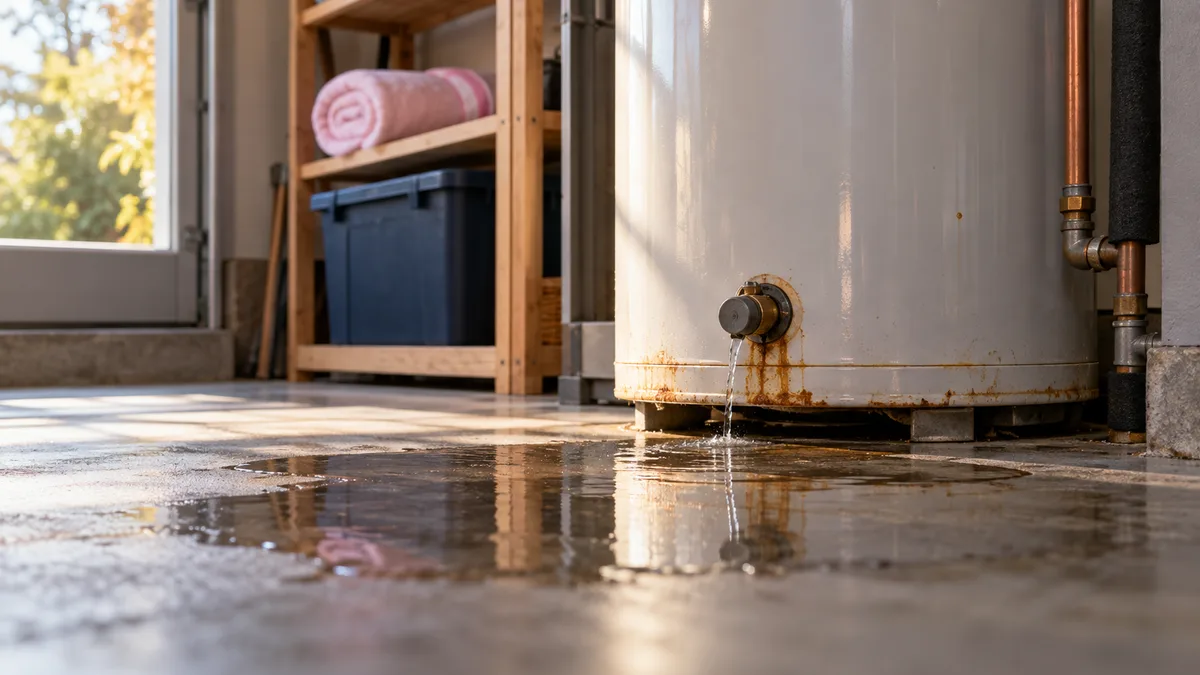
A homeowner walks into the garage and finds a puddle. The water heater is leaking from the bottom of the tank. It's old, nobody remembers exactly how old, and the internet argument starts right away: replace it with another tank or go tankless?
Before anyone picks a new unit, there's an insurance question that decides how much this costs: does homeowners insurance pay for any of this?
In the same week, another homeowner had a supply line burst under a sink. The repair estimate came in between $30,000 and $40,000. Their policy had about $10,000 of coverage for water damage. They also wanted to know if they had to use the contractor the insurance company sent, or if they could use their own guy.
Both questions come up every week. Here's how it works.
Short answer
Homeowners insurance usually does not pay to replace the water heater itself, because a tank that rusts through is wear and tear. It may pay for the water damage the leak caused to your floors, walls, cabinets and belongings, if the water got out suddenly and by accident. It generally won't pay for damage from a slow leak that went on for weeks. And some policies cap water damage at a set dollar amount, so read your declarations page before the leak, not after.
Does homeowners insurance cover a leaking water heater?
It covers the damage the water does in many cases. It usually doesn't cover the heater.
On a standard HO-3 form, the policy covers "an accidental discharge or overflow of water or steam from within a" plumbing system or household appliance. A water heater counts. The same form then says: "We do not cover loss to the system or appliance from which this water or steam escaped."
So split the loss into two piles:
- The water heater. Usually not covered. A tank that corrodes and leaks at the bottom has worn out. The standard form excludes "wear and tear, marring, deterioration."
- What the water hit. Possibly covered: soaked drywall, baseboards, flooring, a finished basement, cabinets, boxes of stuff in the garage. That's your dwelling coverage for the house and personal property coverage for your belongings, after your deductible.
Carrier forms differ. Some policies are written on narrower forms, and some carriers add their own water endorsements. Ask your agent to confirm how yours reads.
What does "sudden and accidental" mean for a water heater?
It means the water got out quickly and you didn't see it coming. A tank that splits and dumps 50 gallons across the basement overnight is the classic covered water loss.
The trouble starts when the leak was slow. If the bottom of the tank has been weeping for two months, the subfloor under it has rotted, and there's mold climbing the wall, the adjuster is going to look at that as long-term leakage and deterioration. Many policies exclude damage from water that leaked repeatedly over a period of time, and mold from long-term moisture is usually limited or excluded too.
Some forms carve out one exception. Some homeowners forms cover a slow leak from plumbing, an appliance or a drain only if it was hidden inside a wall, ceiling or floor and nobody in the house knew about it. A water heater weeping in the open in your garage doesn't fit that exception, because it's in plain sight.
Water heaters are bad for this. They live in garages, closets, attics and basements, places nobody looks at every day. A small drip can run for weeks before anyone notices the stain.
I wrote a whole post on the slow-leak problem: slow plumbing leak under the kitchen floor: covered claim or long-term seepage. Same rules apply to a water heater.
Will insurance pay to tear out the wall to get to the leak?
On a standard form, coverage includes "the cost to tear out and replace any part of a building" when that's necessary to repair the system or appliance. That matters more for a pipe inside a wall than for a water heater sitting in the open.
Some forms put a tighter cap on the expensive version. Some forms pay tear-out only to reach the specific part that leaked, and cutting into a slab or foundation is limited to $2,000 or the cost of a reasonable alternative repair, whichever is less.
If your water heater is in a closet and a plumber has to open drywall or pull a platform apart to replace it, that tear-out may be part of the covered damage. The new water heater still comes out of your pocket.
The burst supply line version of this, where the plumbing is behind the wall, is here: burst supply line, tear-out, and the first estimate.
What is a water damage sublimit?
A sublimit is a smaller cap inside your policy that applies to one type of loss. Your dwelling limit might be $450,000, but if your policy has a $10,000 water damage limit, a $35,000 water loss gets $10,000 minus your deductible.
That's what happened to the homeowner with the burst line under the sink. The claim was paid, up to the $10,000 the policy was written to pay.
Not every policy has a water sublimit. Many policies cover sudden and accidental water damage, like a failed water heater or a burst pipe, up to the full dwelling limit. Water that backs up through a sewer, drain or sump pump is the usual exception: most policies exclude it unless you add backup coverage by endorsement, and that endorsement has its own limit. Other policies do cap water damage at a set amount, and some let you buy the cap back up. The only way to know is to read your declarations page and endorsements, or have someone read them with you.
Example: a water heater in a finished basement lets go overnight.
| Item | Cost |
|---|---|
| New 50-gallon water heater, installed | $2,200 |
| Water extraction and drying | $4,500 |
| Drywall, insulation, baseboards, paint | $9,800 |
| Flooring | $11,500 |
| Damaged belongings (stored boxes, a couch, a rug) | $4,000 |
| Total | $32,000 |
With no water sublimit and a $2,500 deductible: the water heater ($2,200) is yours. The other $29,800 of damage is the claim. After the deductible, the policy pays about $27,300.
With a $10,000 water damage sublimit: the policy pays $10,000 minus the deductible, about $7,500. You're covering roughly $24,500. Same leak, same house. The difference is one line on the declarations page.
These numbers are an example only. How a carrier applies the deductible and the sublimit depends on the policy wording.
Do I have to use the insurance company's contractor?
Usually, no. Most homeowners policies let you pick who does the work, but read your policy, because some carriers have programs or options that change the rules.
A carrier's preferred vendor network is often an option you can take, and it can be a good one: the vendor is already approved, payment is direct, and the work may come with a warranty from the program. You can also get your own estimate from a licensed contractor and send it to the adjuster.
In Tennessee, on a homeowners claim for structural damage estimated at $20,000 or more, the insurer has to give you a written statement of your rights, including the right to have the repairs made by a contractor of your choice who works for you, not the insurer. In Alabama it's written into law for every covered claim. The Alabama Policyholder Bill of Rights (Act 2012-510) says policyholders "shall have the right to select their licensed contractor or vendor to repair, replace, or rebuild damaged property covered by the insurance policy."
Three things to know before you call your brother-in-law's handyman:
- The standard form gives the insurance company an option to repair or replace damaged property itself with "property of like kind and quality," if it notifies you in writing within 30 days of your signed proof of loss. Most carriers don't use it on a typical water claim, but the clause is there.
- The adjuster pays what the damage reasonably costs to fix. If your contractor's bid is much higher than the adjuster's estimate, expect a back-and-forth. A licensed contractor with a line-item estimate holds up better than a number on a napkin.
- Some forms say the reasonable repair cost can be based on discounted pricing the insurer is able to get. You can still hire your own contractor, but the check may be figured at the lower network price, and you'd cover the difference. If the insurer offers to send a crew for emergency work, you can say no.
What should I do the minute I find the leak?
Stop the water, then document everything. Your policy requires you to protect the property from more damage, and it pays reasonable costs to do that.
- Shut off the water to the heater. The cold-water supply valve is usually on the pipe at the top of the tank. If you can't find it or it won't turn, shut off the main to the house.
- Turn off the power or gas. Electric: flip the breaker. Gas: turn the control knob to off or pilot. If you smell gas, leave and call the gas company.
- Take photos and video before you clean. The tank, the label with the model and serial number, the floor, the walls, the waterline on drywall, wet boxes.
- Get the water out. Towels, a wet vac, fans. If water reached drywall, carpet or a finished basement, a professional water mitigation company is often worth it. The standard form covers "reasonable cost incurred by you for the necessary measures taken solely to protect covered property" from further damage. Keep the receipts.
- Call your agent before you file. Ask whether the damage is likely covered, whether a sublimit applies, and whether the number is worth a claim.
- Get one estimate for the damage. Then decide.
Be careful with step 4. Most mitigation companies are honest. Some will push a big tear-out and ask you to sign an assignment of your insurance benefits on a phone screen. Read what you sign. If the crew can't explain why a wall has to come out, ask for the moisture readings and a written scope before they start.
Is it worth filing a claim for a water heater leak?
Sometimes not. If the water stayed on a concrete garage floor and nothing else got wet, there may be no claim at all, because the only loss is the heater.
If the damage is $3,500 and your deductible is $2,500, you'd be filing to collect $1,000 and adding a water claim to your history. Water claims are a big deal to underwriters, because one water loss is a predictor of another. A claim generally shows on your CLUE report for up to 7 years.
If the damage is $30,000, file. That's what the policy is for.
The gray area is in between, and that's where a 10-minute conversation with your agent pays for itself. More on that in I called to ask a question. They opened a claim. Now what? Ask your agent, not the claims line, if you just want to know whether something's covered.
How long does a water heater last?
The U.S. Department of Energy says a storage tank water heater lasts 10 to 15 years, and a tankless (demand) unit lasts about 20 years.
Georgia, Alabama and Tennessee have plenty of houses with the original builder-grade tank still in the garage. If yours is past 10 years old, assume it's on borrowed time. The serial number on the label usually encodes the manufacture date; the manufacturer's website or a plumber can decode it.
Warning signs your tank is near the end:
- Rust-colored hot water, or rust on the tank near the bottom or around fittings
- Water around the base, even a little
- Rumbling or popping noises from sediment
- Hot water that runs out faster than it used to
- A pressure relief valve that drips
Tank or tankless, from an insurance view
Your insurance company won't care much which one you pick. A tankless unit holds very little water, so a failure usually means a smaller leak. A tank holds 40 to 80 gallons and can empty all of it.
Location changes the size of a loss. A water heater in an attic or an upstairs closet can do damage to two floors. If yours is above living space, a drain pan plumbed to a drain is cheap insurance. Georgia's statewide minimum codes include the International Residential Code, which requires a pan under a tank water heater installed where a leak would cause damage, piped to a drain or to the outside. In Alabama and Tennessee, ask your plumber which code your city or county enforces.
Do leak detectors and automatic shutoffs lower your premium?
Often, yes. Some carriers give a good discount for a whole-home automatic water shutoff device, and some also discount the device itself. The amount depends on the carrier and the state, so ask your agent what yours gives. We cover one option on our water leak protection page.
The device earns its keep either way. A $30 leak sensor under the water heater that beeps at the first drop turns a $30,000 loss into a wet towel. An automatic shutoff valve on the main line can stop the water before you even get home.
Home warranty vs. homeowners insurance for a water heater
They do different jobs.
- A home warranty is a service contract. It may repair or replace a water heater that fails from normal wear, subject to its own limits, exclusions and service fee. It usually doesn't pay for the water damage.
- Homeowners insurance pays for sudden, accidental damage to the house and your stuff. It usually doesn't pay for the worn-out appliance.
If you want both pieces handled, you need both products. Our home warranty page covers how a warranty works. Read the warranty contract for water heater limits and code-upgrade exclusions before you count on it.
What to check on your policy this week
- Your water damage limit. Look for a water sublimit or a water damage endorsement on the declarations page. If you see one, find out what it costs to raise it.
- Your deductible. And whether water losses have a separate deductible.
- Water backup coverage. Sewer and drain backup is a separate coverage on most policies. It's not the same as a water heater leak, but people mix them up.
- The age of your water heater. If it's over 10 years old and sits above a finished floor, price a replacement before it picks the date for you.
Send me your declarations page
I do a free Claim Ready Coverage Check. Send me your current declarations page and I'll go through every line of it and tell you what a water heater leak or a burst pipe would actually pay at your house: your water limit, your deductible, your backup coverage, and where you're short.
If you want a quote, start at ins.insure/quote, email michael@ins.insure, or call 678-578-7009. We write home and auto in Georgia, Alabama and Tennessee.
Frequently asked questions
Does homeowners insurance cover a leaking water heater?
Homeowners insurance usually does not pay to replace the water heater itself, because a tank that wears out and leaks is wear and tear. It may pay for sudden, accidental water damage the leak caused to the house and your belongings, minus your deductible. Damage from a slow leak that went on for weeks is often excluded.
Will insurance pay for a new water heater?
Usually not. The standard HO-3 form says the insurer does not cover loss to the system or appliance the water escaped from. A home warranty or service contract is the product that may repair or replace a failed water heater.
What is a water damage sublimit on a homeowners policy?
It's a lower dollar cap that applies only to certain water losses, even if your dwelling limit is much higher. For example, a $10,000 water limit pays at most $10,000 on a $35,000 water loss, before the deductible. Check your declarations page and endorsements to see if your policy has one. Many policies have no separate cap for sudden leaks, but water that backs up through a sewer, drain or sump pump usually needs its own endorsement.
Do I have to use my insurance company's preferred contractor for water damage?
Usually not, but check your policy wording. Many carriers offer a preferred vendor network as an option, and you can usually submit an estimate from your own licensed contractor. In Alabama, the Policyholder Bill of Rights gives policyholders the right to select their licensed contractor or vendor. In Tennessee, on homeowners claims for structural damage of $20,000 or more, the insurer must tell you in writing that you can use a contractor of your choice.
How long do water heaters last?
The U.S. Department of Energy says storage tank water heaters last 10 to 15 years and tankless water heaters last about 20 years. A tank past 10 years old with rust or water at the base is close to failing.
Is a slow water heater leak covered by insurance?
Often not. Many policies exclude damage from water that leaked repeatedly over weeks or months, and mold from long-term moisture is usually excluded or limited. Leak sensors near the water heater help catch a drip before it becomes that kind of loss.
Should I file a claim for water heater damage?
Compare the damage estimate to your deductible first. If the water damage is only slightly above the deductible, the payout may not be worth a water claim on your record, which can follow you for up to 7 years on a CLUE report. A large loss is what the policy is for, so file it.
Sources
- ISO Homeowners 3 Special Form HO 00 03 05 11, copy hosted by the Maine Bureau of Insurance: Standard wording on accidental discharge of water from a household appliance, the exclusion for the appliance itself, tear-out, wear and tear, reasonable repairs, duties after loss and the insurer's option to repair. Carrier forms can differ.
- U.S. Department of Energy, Energy Saver: Which water heater is right for you?: Storage water heaters last 10 to 15 years; tankless (demand) water heaters last about 20 years.
- Tennessee Department of Commerce and Insurance: C.L.U.E.: A CLUE report generally contains up to seven years of personal auto and property claims history.
- NAIC: Assignment of benefits, consumer beware: Explains what an assignment of benefits is and advises reading the contract before signing, getting multiple bids and documenting damage before cleanup.
- Alabama Homeowners Bill of Rights Act, HB166 (2012 Regular Session), Alabama Legislature: Section 3(10): policyholders have the right to select their licensed contractor or vendor to repair, replace or rebuild damaged property covered by the policy. Enacted as Act 2012-510.
- Alabama Department of Insurance: Homeowners Bill of Rights Act: The Department's consumer page for the Act, still posted.
- Tenn. Code Ann. 56-7-125, policyholder statement of rights on property claims (FindLaw): On a homeowners or fire claim for structural damage estimated at $20,000 or more, the insurer must give a written statement of rights, including the right to have repairs made by a contractor of the policyholder's choice who does not work for the insurer.
- Georgia Department of Community Affairs: current state minimum standard codes: The International Residential Code and International Plumbing Code (2024 editions with Georgia amendments) are mandatory state minimum codes.