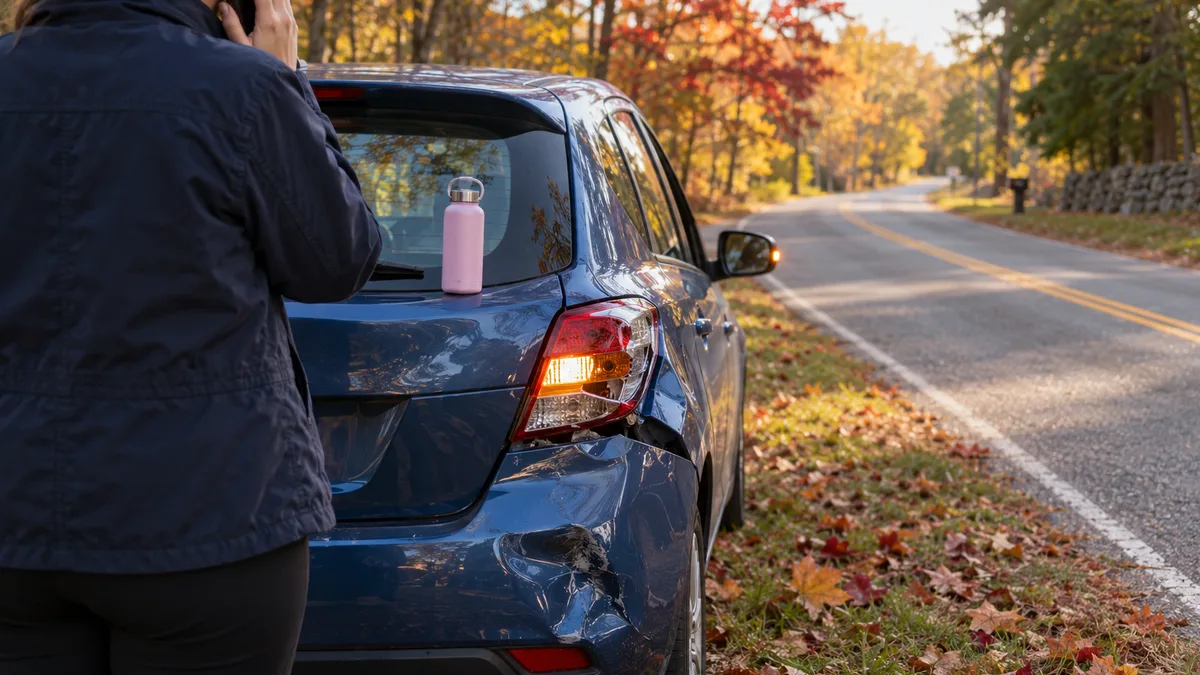
Somebody runs into you. Your car can't be driven. You do what you're supposed to do: get their information, call their insurance company, open a claim.
Then the adjuster starts hinting that the policy "might not cover this."
And then you remember your own policy is liability only. No collision. No uninsured motorist coverage. Nothing on your side that pays for your car.
A family posted almost exactly this recently, and the comments filled up fast with people who'd been stuck in the same spot.
Short answer: Liability-only coverage pays for damage you cause to other people. It pays nothing for your own car. If the at-fault driver's insurer denies the claim, your remaining options are to pursue the at-fault driver personally (small claims court or a lawsuit), to file a complaint with your state insurance department if the claim is being handled badly, and to use any uninsured motorist coverage you carry. In Georgia, UM can pay for damage to your car when the other driver's insurer has legally denied coverage, but only if you have UM on your policy.
Why would the other driver's insurance deny my claim?
Usually for one of two reasons: they dispute who was at fault, or they're questioning whether their own policy covers this driver, this car, or this trip.
Fault disputes are the common one. Their insurer only pays if their insured is legally responsible. If the stories don't match and there's no police report or witness, they may sit on it or deny it.
Coverage questions are the scary one. A few reasons an insurer might say its own policy doesn't apply:
- The policy lapsed or was canceled before the wreck, often for nonpayment.
- The driver was specifically excluded on the policy by name.
- The driver borrowed the car without permission.
- The car was being used for something the policy excludes, like some delivery or business use.
- The insured didn't report the accident or isn't cooperating with their own insurer.
Whether any of these holds up depends on the policy and state law. You won't get to read their policy. What you can do is get their answer in writing.
What does "we're still investigating coverage" mean?
It means the insurer hasn't decided whether its policy applies yet. Often it has sent its own policyholder a reservation of rights letter, which says, in effect: we're looking into this, and we're not promising to pay.
A stall and a denial are different for you. While it's an investigation, you wait, document everything, and keep pushing for a decision. Once it's a denial in writing, other doors open, including uninsured motorist coverage in Georgia.
Ask the adjuster these questions, and ask for the answers by email:
- What's the claim number and your direct contact information?
- Has coverage been confirmed on this policy, yes or no?
- Has your company accepted liability for the accident?
- If coverage is being denied, what's the reason, and can you send that in writing?
- When do you expect to make a decision?
Does my liability-only policy pay anything when someone else hits me?
Not for your car. Liability coverage pays for injuries and property damage you cause to others. Collision is the coverage that pays for your car after a wreck. Uninsured motorist coverage is what pays when the other side has no insurance.
A couple of things might still be on your policy even if you think of it as "liability only":
- Uninsured motorist coverage. In Georgia, UM is part of the policy unless someone rejected it in writing. Plenty of people have it and don't know.
- Medical payments coverage, which pays medical bills for you and your passengers regardless of fault, up to a small limit.
- Rental reimbursement or towing, if you added them.
Pull your declarations page tonight and look. If a coverage isn't listed, assume you don't have it.
Can uninsured motorist coverage pay for my car?
It depends on your state and what you bought.
Georgia
Georgia's UM law covers property damage, including your car and personal property inside it. You pick a UM property damage deductible of $250, $500 or $1,000.
Here's the part that matters for a denied claim. Under the Georgia statute, a vehicle counts as uninsured when its liability insurer "has legally denied coverage under its policy," or when the insurer is insolvent. So if the at-fault driver's insurer formally denies coverage, your UM may step in as if they had no insurance at all. Some Georgia auto policies say the same thing in their own definition: a vehicle is uninsured if its insurer denies coverage or is insolvent. UM property damage still requires that the other driver was at fault, and your UM deductible applies.
Georgia UM applies on top of the at-fault driver's coverage by default. You can choose the lower "reduced by" version only in writing, and you can reject UM entirely only in writing. If you never signed anything, check your dec page; you may have more protection than you think. I wrote a whole post on why UM is the coverage people reject without knowing it.
Alabama
Alabama's UM statute is written around bodily injury: it covers people who are legally entitled to recover from an uninsured driver for injury, sickness or death. It doesn't mention damage to your car, and a typical Alabama auto policy follows that: UM pays for injuries, not for your car. In Alabama, collision is the dependable way to get your own car fixed when the other side won't pay.
Tennessee
In Tennessee, an auto policy includes UM unless you reject it in writing or choose lower limits. If you carry UM for injuries, the insurer has to offer you UM property damage too. By law, UM property damage carries a $200 deductible, and that deductible doesn't apply if the same insurer carries your collision and your UM property damage, or if the other driver is positively identified and solely at fault. Ask your agent exactly how UM property damage is set up on your policy.
Uninsured motorist property damage vs. collision: what's the difference?
Both can fix your car. They work very differently.
| Collision | UM property damage | |
|---|---|---|
| Pays when | You hit something or something hits you, regardless of fault | An uninsured driver hits you (in Georgia, also when their insurer legally denies coverage) |
| Waits on the other insurer? | No. Your insurer pays, then chases the other side | Usually needs the other driver to be uninsured or denied |
| Deductible | Your collision deductible, often recovered if the other side pays | Set by your UM selection (in Georgia, $250, $500 or $1,000) |
| Required by your lender? | Almost always, on a financed or leased car | No |
| Hit and run, at-fault single-car wreck | Covered, subject to policy terms | At-fault wrecks aren't covered; hit and run has reporting rules (see below) |
On hit and run, read your policy's fine print. On some Georgia policies, UM covers a hit-and-run vehicle that actually hits you or your car, as long as the wreck is reported to police within 24 hours (or as soon as you reasonably can) and to the insurer within 30 days. If the other car never touched yours, the damage claim needs an eyewitness other than you to back up what happened.
If you can't afford to replace your car out of pocket, collision is the coverage that protects you from exactly this situation. You file with your own insurer, get your car fixed or paid off, and let your insurer argue with theirs.
What are my options if I only have liability?
Here's the order I'd work in.
- Lock down the evidence. Police report number, photos of both cars and the scene, witness names and phone numbers, the other driver's license and policy information.
- Stop the storage bill. Tow yards charge by the day. If the car is sitting at a storage lot, ask how much it costs per day and move it somewhere cheaper, even your driveway, once the adjuster has inspected it or agrees it can move.
- Open the claim and get it in writing. Claim number, adjuster, and the five questions above, by email.
- Keep every receipt. Towing, storage, rental, rideshares, repair estimates. These are part of what the at-fault side owes.
- Check your own policy for UM, medical payments and rental coverage.
- If the insurer stalls, file a complaint with your state insurance department (numbers below).
- If the insurer denies, get the reason in writing. If it's a coverage denial in Georgia and you have UM, open a UM claim with your own insurer.
- If nothing pays, pursue the at-fault driver directly.
Can I sue the other driver if their insurance won't pay?
Yes. Their insurer's decision doesn't erase the driver's own responsibility for the damage they caused. You can pursue the driver personally.
In Georgia, small claims cases go to magistrate court, which handles claims up to $15,000. That limit goes up to $25,000 for cases filed on or after January 1, 2027. You file in the county where the defendant lives, a judge hears it, and you can represent yourself. The catch: if you win, collecting the money is on you. A judgment against someone with no insurance and no assets can be hard to turn into a check.
Georgia gives you 4 years to bring a case for damage to personal property, which includes your car. Injury claims have a different, shorter deadline, so if anyone was hurt, talk to a lawyer licensed in your state soon. I'm not a lawyer, and this isn't legal advice.
Alabama and Tennessee have their own small claims courts, limits and deadlines. Check with the clerk of court in your county before you file.
How do I file a complaint against the other driver's insurance company?
Your state insurance department handles complaints about how a claim is being handled, including delays and unexplained denials. It can't force an insurer to pay a claim it isn't legally required to pay, but it can get you a response and a written explanation.
- Georgia: Office of Insurance and Safety Fire Commissioner, Consumer Services, (800) 656-2298 or (404) 656-2070.
- Alabama: Department of Insurance, 334-241-4141, or the online complaint form. They ask you to contact the insurer first, and they can't help if you've hired an attorney.
- Tennessee: Department of Commerce and Insurance, Consumer Insurance Services, 615-741-2218 or 1-800-342-4029. Formal complaints are filed online.
Include the claim number, the insurer's name, the adjuster, dates of every contact, and copies of your emails.
What can I claim from the at-fault driver or their insurer?
- Repairs, or the actual cash value if your car is totaled. If they total it, here's how to check their number.
- Towing and storage.
- Loss of use, meaning a rental or the reasonable cost of being without a car while it's repaired.
- Diminished value. A repaired car with an accident history is often worth less than the same car without one. Georgia law lets you claim that loss from the at-fault driver, measured by the drop in value from before to after the wreck, or by repair cost plus any lasting loss in value, capped at what the car was worth before. Alabama courts also measure car damage in a claim against the at-fault driver by the drop in fair market value from before to after the wreck. Tennessee is less settled, so ask a Tennessee lawyer before you count on it.
- Medical bills and other injury damages, if anyone was hurt.
Is liability-only worth the savings?
Sometimes. If your car is worth $3,000 and you could replace it with cash next week without missing a bill, liability-only can be a reasonable choice.
If losing the car would wreck your month, run the math.
Example: Your car is worth $12,000. Someone hits you and their insurer denies coverage. With liability only and no UM, you're chasing $12,000 through a court process, and you might collect some of it, all of it, or none of it. With collision and a $1,000 deductible, your insurer pays $11,000 for the car, then goes after the other side for its money and your deductible. With Georgia UM property damage and a $250 deductible, a formal coverage denial may let you collect from your own policy.
The question to ask yourself is how long you could go without a car, and what it would cost to replace it. If the answer is "not long" and "more than I have," liability-only is a risk you're carrying for every other driver on the road.
If your premium went up and you dropped collision or UM to save money, I get it. Before you do it again, read what usually comes out of a cheaper renewal.
What to check on your policy today
- Do you have collision, and what's the deductible?
- Do you have uninsured motorist coverage? In Georgia, is it "added on" or "reduced by," and does it include property damage?
- Do you have rental reimbursement?
- Do you have medical payments coverage?
- Did anyone in your household sign a UM rejection or a lower-limit form?
Let me read your dec page
I'll do a free Claim Ready Coverage Check on your auto policy. Send me your declarations page and I'll tell you what happens if someone with no insurance, or an insurer that won't pay, hits you tomorrow: what pays for your car, what pays your medical bills, and what you'd be chasing on your own.
Email michael@ins.insure, call 678-578-7009, or start a quote here. More on auto insurance at INS.
Frequently asked questions
What happens if the at-fault driver's insurance denies my claim?
Their insurer won't pay, but the driver is still personally responsible for the damage they caused. You can use your own collision or uninsured motorist coverage if you have it, file a complaint with your state insurance department if the claim was handled badly, and pursue the driver in small claims court or with a lawsuit.
Does liability-only insurance cover my car if someone else hits me?
No. Liability coverage pays for damage and injuries you cause to other people. Collision pays for your car regardless of fault, and uninsured motorist coverage can pay when the other driver has no insurance.
Does uninsured motorist coverage apply if the other driver's insurance company denies coverage in Georgia?
It can. Georgia's UM statute treats a vehicle as uninsured when its liability insurer has legally denied coverage under its policy or is insolvent, and Georgia auto policies use the same idea in their definition of an uninsured motor vehicle. Georgia UM includes property damage to your car, with a deductible of $250, $500 or $1,000.
Does Alabama uninsured motorist coverage pay for car damage?
Alabama's UM statute is written for bodily injury, sickness or death and doesn't mention property damage. In Alabama, collision coverage is the dependable way to cover your own car when the other side won't pay. On a typical Alabama policy, UM pays for injuries, not for damage to your car.
How much can I sue for in Georgia small claims court?
Georgia magistrate court hears small claims up to $15,000. You file in the county where the defendant lives, a judge decides the case, and you can represent yourself. If you win, you're responsible for collecting the judgment.
How long do I have to sue for car damage in Georgia?
Georgia law gives 4 years to bring an action for damage to personal property, which includes a vehicle. Injury claims have a different deadline, so talk to a lawyer licensed in Georgia if anyone was hurt.
Can I file a complaint against another driver's insurance company?
Yes. Your state insurance department takes complaints about delays and unexplained denials, even from people who don't hold a policy with that insurer. Georgia OCI is at (800) 656-2298, Alabama DOI at 334-241-4141, and Tennessee TDCI at 615-741-2218.
Sources
- O.C.G.A. 33-7-11, Georgia uninsured motorist coverage (Syfert copy): Georgia UM includes property damage to the insured vehicle and contents, with $250, $500 or $1,000 deductibles; a vehicle is uninsured when its insurer has legally denied coverage or is insolvent; UM applies in excess of the at-fault limits unless the insured selects otherwise in writing, and can be rejected only in writing.
- Ala. Code 32-7-23, uninsured motorist coverage (Justia, 2025 Code of Alabama): Requires UM protection for people legally entitled to recover from uninsured drivers because of bodily injury, sickness or disease, including death. No property damage requirement. The named insured may reject the coverage.
- Tenn. Code Ann. 56-7-1201, uninsured motorist coverage (Justia, 2025 Tennessee Code): Auto liability policies include UM unless the named insured rejects it in writing or picks lower limits. Insureds who buy UM bodily injury must be offered UM property damage, with a $200 deductible that doesn't apply if the same insurer carries collision and UM property damage, or the other driver is positively identified and solely at fault.
- Tennessee Department of Commerce and Insurance bulletin on uninsured motorist recovery (June 29, 1993): Explains that under T.C.A. 56-7-1201 the $200 UM deductible is waived only when the uninsured motorist is positively identified and solely at fault.
- O.C.G.A. 9-3-31, actions for injuries to personalty (Justia, 2022): Actions for injuries to personal property must be brought within four years.
- Nolo: Georgia small claims in magistrate court: Georgia magistrate court small claims cap of $15,000, venue in the defendant's county, judge only, plaintiff collects the judgment.
- Georgia HB 999 (2026), as passed House and Senate, Office of the Governor: Raises the magistrate court civil limit in O.C.G.A. 15-10-2 from $15,000 to $25,000 for actions filed on or after January 1, 2027.
- Merlin Law Group summary of Georgia automobile subrogation and diminished value: Third-party diminished value in Georgia measured as the difference in value before and after the collision, or repair cost plus permanent impairment.
- Georgia Office of Insurance and Safety Fire Commissioner: report complaints: Consumer Services phone numbers and the claim-handling complaint process.
- Alabama Department of Insurance: file a consumer complaint: Contact the insurer first; online form or 334-241-4141; no assistance if you have an attorney.
- Tennessee Department of Commerce and Insurance: insurance complaint instructions: Consumer Insurance Services at 615-741-2218 or 1-800-342-4029; formal complaints online.
- Georgia Court of Appeals, 237 Ga. App. 515 (1999), measure of car damage against the other driver (vLex): In a damage claim against the other driver, the owner may recover repair cost, loss of use and permanent impairment, as long as the total doesn't exceed the car's fair market value before the wreck, or may prove the difference in fair market value before and after.
- NAIC Journal of Insurance Regulation: Automobile Diminished Value Claims (2023): Lists Georgia among the states that allow recovery for diminished value in a third-party claim.
- Alabama Court of Civil Appeals, No. 2000850 (2002), on diminished value (FindLaw): Notes that in a tort action against a negligent driver, Alabama measures car damage by the difference in fair market value before and after the collision (citing Robbins v. Voigt). The case itself is a first-party claim, which the court treated differently.