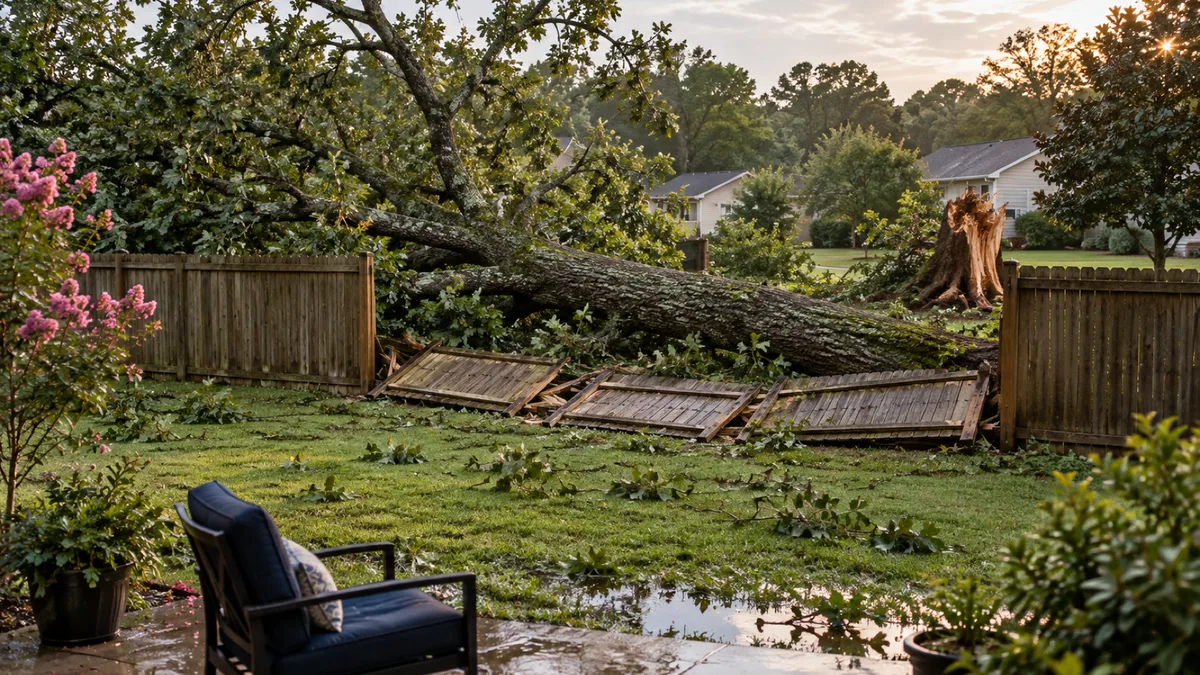
A storm rolls through overnight. In the morning, the neighbor's big oak is lying across the back fence, and three sections of privacy fence on your side of the line are flat in the yard.
The neighbor comes over, apologizes, and says he already called his insurance company. So now you're standing there with your coffee wondering two things. Do you call your own carrier too? And is filing going to raise your rate over a fence you didn't knock down?
A homeowner asked almost exactly this online a few weeks ago and got 74 comments of mixed advice. Here's how it actually works.
Short answer: When a neighbor's healthy tree falls on your house or fence, your own homeowners policy usually pays for your damage, minus your deductible. The neighbor's policy pays only if the neighbor was negligent, which generally means the tree was dead, diseased or visibly dangerous and they knew or should have known. Before you file anything, compare the repair estimate to your deductible, because a small fence claim can cost you more over time than it pays.
Whose insurance pays when a neighbor's tree falls on my property?
Yours does, in most cases. Insurance follows the damaged property, so the policy on the house or fence that got hit is the one that responds first.
That surprises a lot of people. It feels backward. It's his tree, so why is it your claim?
Because in most storms, nobody did anything wrong. A healthy tree that comes down in high wind is treated like any other wind damage. There's no one at fault, so there's no one's liability coverage to bill. Your own property coverage steps in, the same way it would if the wind had peeled off a few shingles.
The neighbor calling his carrier doesn't change that. His carrier will look at the facts, and if the tree was healthy, it will usually tell him (and you) that he isn't liable. Then you're back to your own policy, just a week later.
When is the neighbor responsible for the tree that fell?
The neighbor is generally responsible when the tree was dead, rotting, leaning badly or otherwise dangerous, and they knew about it or should have known. That's negligence, and that's when their liability coverage can come into play.
The University of Georgia Extension puts it plainly for Georgia: a tree owner is liable for damage from a falling tree only if they had prior knowledge that it was diseased, decayed or dangerous. Georgia doesn't require homeowners to inspect their trees on any schedule. If the tree looked normal, with leaves and a typical shape, the owner generally isn't at fault.
Knowledge is the whole case. The easiest way to prove it is something in writing that existed before the tree fell:
- A letter or email from you saying the tree looks dead and asking them to deal with it
- An arborist's report that flagged the tree
- A notice from the city, county or HOA
Without something like that, it's very hard to show the neighbor should have known. Tennessee's Supreme Court has said a dead or decaying tree that falls is usually judged by negligence, which turns on whether the owner knew or should have known it was dying. For a healthy tree whose branches or roots damage a neighbor's property, Tennessee allows a nuisance claim. Alabama's rules aren't spelled out the same way, so ask a local lawyer there. In all three states, putting your concern in writing helps. The legal details are a question for a lawyer, but the documentation habit costs you a stamp.
What if the tree was on the property line?
Ownership follows the trunk. If the trunk sits entirely on the neighbor's side, it's the neighbor's tree, even if most of the branches hang over your yard. If the trunk straddles the line, you share it. A survey settles the question when it matters.
Can I cut the branches hanging over my yard?
In Georgia you can generally trim branches that cross onto your property, up to the line. UGA Extension recommends talking to the tree owner first and putting any agreement in writing before an arborist touches a neighbor's tree. Don't damage the tree itself doing it.
Does homeowners insurance cover a fence damaged by a fallen tree?
Usually, yes. A fence is an "other structure" on most homeowners policies, which is Coverage B.
On a standard homeowners form, Coverage B covers structures on your property set apart from the house, and it specifically includes structures connected to the house by only a fence or utility line. On the standard ISO form, the limit is 10% of your dwelling limit. On a $400,000 dwelling limit, that's $40,000 for the fence, detached garage, shed and everything else in that bucket combined. Some forms list the separate structures limit as its own dollar amount on the declarations page, and fences can be settled at replacement cost or actual cash value depending on what the declarations say. Check yours.
Wind is a covered cause of loss on most homeowners policies, so a fence knocked down by a tree in a windstorm is the kind of damage Coverage B is built for. So the fence is usually covered. Whether the claim is worth filing is the next question.
Does insurance pay to remove a fallen tree?
Only in specific cases, and the limit depends on your form. On the standard ISO form, tree removal is paid when the tree damaged a covered structure, or when it blocks your driveway or a wheelchair ramp, and the limit is $1,000 per loss and no more than $500 per tree.
Some forms handle it differently. On some homeowners forms, removing a tree that first damaged the house or a covered structure like the fence counts as debris removal for that claim. It's paid inside your dwelling or separate structures limit, with no separate $500 per tree cap. Some of those forms have no driveway or ramp provision, so a tree blocking the driveway that didn't damage anything may not be covered for removal.
A tree that falls across the fence counts, because the fence is a covered structure. A tree that falls in the middle of the backyard and hits nothing usually gets $0 for removal. You pay for that one yourself.
Here's the part people don't expect. A big pine lying across a roof can take a crane and a crew to remove, and those bills run past $1,000 fast. On a form with the $1,000 cap, the removal limit doesn't grow because the tree was large. Some carriers sell higher limits by endorsement. Ask your agent to confirm what yours says, because carrier forms differ.
The trees and shrubs in your own landscaping are a separate coverage, and on a standard form windstorm isn't one of the causes it covers. So if the storm takes down your favorite maple, don't count on a check to replace the maple.
Should I file a claim on my own insurance for a fence?
Run the math first. If the repair is close to or below your deductible, filing gets you little or nothing and can still put a claim on your record.
Many homeowners policies in Georgia, Alabama and Tennessee carry a separate wind or hail deductible, and on some policies it's a percentage of the dwelling limit instead of a flat dollar amount. A 1% wind deductible on a $450,000 dwelling is $4,500. That's more than most fence repairs.
Other policies work differently. On some base forms, an ordinary windstorm falls under your regular deductible, and a separate percentage deductible applies only to a named hurricane. Some policies also let you choose a split deductible: one amount for wind and hail, another for everything else. A split deductible can lower the premium, and it makes sense for some households, as long as you know the wind number in dollars before a storm hits. Endorsements can change all of this, so look at your own declarations page.
Example (on a form with the standard $500 per tree removal cap and a separate wind deductible): The tree takes out 3 sections of 6-foot wood privacy fence. The fence company quotes $2,400 to replace them. Tree removal off the fence runs $900. Your all-other-perils deductible is $1,000, but your policy has a $2,500 wind deductible, and this was a windstorm.
| Item | Amount |
|---|---|
| Fence repair | $2,400 |
| Tree removal (within the $500 per tree limit) | $500 |
| Total covered damage | $2,900 |
| Wind deductible | minus $2,500 |
| Check from your carrier | $400 |
You'd be filing a claim to collect $400, and you'd still be paying $400 of the removal yourself because of the $500 per tree cap. That claim can follow your address and your name on the claims database insurers check for years. I walk through that database in the post about a coverage question that turned into a claim.
Now change one number. Same storm, but the tree also crushes a corner of the roof and the estimate is $14,000. That's a claim. File it.
The rule of thumb I give clients: get an estimate before you report anything. If the check would be small, think hard. If it's big, file it and don't feel bad about it. That's what you pay premium for.
Can I get my deductible back from the neighbor?
Only if the neighbor was at fault. If your carrier pays your claim and believes the neighbor was negligent, it can go after the neighbor's carrier to recover what it paid. That's called subrogation. When it works, you may get your deductible back too.
If the tree was healthy and the storm knocked it down, nobody owes you the deductible. Your neighbor isn't legally required to cover it. Some neighbors offer anyway, and that's a kind thing to do.
What if the tree hits my car, my shed or my roof?
Each one goes to a different place:
- Your car: Homeowners policies exclude motor vehicles. A tree on your car goes to the comprehensive coverage on your auto policy, if you carry it, minus your comprehensive deductible. If you only carry liability on that car, there's no coverage for the damage. See auto insurance for what comprehensive does.
- Your shed or detached garage: Coverage B, other structures, same as the fence.
- Your roof or house: Coverage A, your dwelling coverage, subject to your deductible. Tree removal follows the same rules as the fence: capped at $1,000 per loss and $500 per tree on the standard ISO form, and part of the claim's debris removal on some other forms.
One storm, one tree, can mean a home claim and an auto claim with two different deductibles. Worth knowing before the adjuster calls. Some carriers that write both your home and car offer a single loss deductible, so only the larger deductible applies when one event damages both. It has to show on both declarations pages, so ask.
A branch hit my roof. What should I document?
Take photos and video before anything gets moved, and keep every receipt. That's the short version.
- Photograph the whole scene first. Wide shots that show where the tree came from, then close-ups of the damage, the roof, the fence, the trunk and the root ball or break point. A broken trunk with rot inside it is evidence. A clean break of healthy wood tells a different story.
- Get the date and the weather. Note the date and time. Screenshot the local storm report or wind warning.
- Stop more damage. If a branch punctured the roof, get it tarped. Your policy expects you to protect the property from further damage, and reasonable costs to do it are typically part of the claim. Keep the invoice.
- Don't throw out the evidence. If you think the neighbor's tree was rotten, ask the tree crew to leave a section of the trunk, or at least photograph the cut ends.
- Get one repair estimate before you call the claims line. Then decide.
- Look for water inside. Check the attic and ceilings over the next few days. Water from a storm-damaged roof is usually covered as part of the same loss. Water that shows up months later is a harder conversation.
Should I call my agent or the claims line first?
Call your agent first. An agent can read your policy, tell you your deductible and limits, and help you decide whether to file, without opening a claim file.
When you call a claims line, the person on the other end is there to take a claim. Ask a "would this be covered?" question there and you may end up with a claim file you never meant to open. In Georgia, state law says a question about coverage doesn't by itself count as a claim, but you're better off never having to argue that point.
In practice, most carriers open a claim when you call the claims line, even if all you did was ask a question. When you call our office with a question, we answer it. We don't open a claim unless you ask us to.
What should I do if the neighbor's tree looks dangerous right now?
Put it in writing. A dated, polite letter or email to the neighbor, with a photo, saying the tree looks dead or dangerous and asking them to have it checked.
- It gives your neighbor a fair chance to deal with it.
- It creates the written notice that matters if the tree later falls on your house.
- Keep a copy. Send it again if nothing happens in a few months.
If it's your own tree that's sick, the same logic runs the other way. Get it looked at and taken care of before it lands on someone else's roof. It's cheaper than a lawsuit, and a lot cheaper than a falling-out with the people next door.
What to check on your policy before the next storm
- Your wind or hail deductible. Is it a flat dollar amount or a percentage? What is it in dollars?
- Your Coverage B limit. Whether it's 10% of your dwelling limit or its own dollar amount, is it enough to rebuild your fence, shed and detached garage at today's prices?
- Your tree removal limit. Is it capped at $1,000 per loss and $500 per tree, or handled as debris removal inside your coverage limits?
- Comprehensive on every car. Especially the one that parks under the big oak.
- Your dwelling limit. If a tree takes out half the house, the rebuild cost is what matters. Our rebuild cost calculator gives you a starting number.
Send me your dec page before the tree falls
The worst time to find out you have a $4,500 wind deductible is while you're standing next to a crushed fence.
I do a free Claim Ready Coverage Check. Send me your declarations page and I'll read every line: your wind deductible in real dollars, your other structures limit, your tree removal limit, and the gaps you'd want to know about now. You'll get a straight answer on which claims are worth filing, too.
Email it to michael@ins.insure, call 678-578-7009, or start a quote here. We write home and auto in Georgia, Alabama and Tennessee.
Frequently asked questions
Whose insurance pays if my neighbor's tree falls on my house?
In most cases your own homeowners insurance pays for the damage to your house, minus your deductible. The neighbor's insurance pays only if the neighbor was negligent, which generally means the tree was dead, diseased or visibly dangerous and they knew or should have known.
Is my neighbor liable if their healthy tree falls in a storm?
Generally no. In Georgia, a tree owner is liable for a falling tree only if they knew or had reason to know it was diseased, decayed or dangerous. A healthy tree knocked down by wind is usually treated as no one's fault.
Does homeowners insurance cover a fence damaged by a fallen tree?
Usually yes. A fence is an other structure, Coverage B, on most homeowners policies, and wind is a covered cause of loss on most forms. On the standard ISO form, Coverage B is 10% of the dwelling limit; some forms list it as its own dollar amount. Your deductible applies.
Does homeowners insurance pay to remove a fallen tree?
On the standard ISO form, it pays to remove a tree that damaged a covered structure or blocks a driveway or wheelchair ramp, up to $1,000 per loss and $500 per tree. Some forms instead treat removal of a tree that damaged the house or fence as part of that claim's debris removal, with no separate per tree cap. A tree that falls and hits nothing usually isn't covered for removal. Carrier forms differ, so check your policy.
Should I file a claim for a fence damaged by my neighbor's tree?
Compare the repair estimate to your deductible first, including any separate wind or hail deductible. If the check would be small, paying out of pocket can be the better choice because a claim stays on your loss history for years. If the damage is large, file it.
Can I get my deductible back from my neighbor?
Only if the neighbor was at fault. If your insurer pays and believes the neighbor was negligent, it can recover from the neighbor's insurer through subrogation, and you may get your deductible back. If the tree was healthy, the neighbor doesn't owe you the deductible.
Does homeowners insurance cover a tree that falls on my car?
No. Homeowners policies exclude motor vehicles. Tree damage to a car is covered by comprehensive coverage on your auto policy, if you carry it, minus the comprehensive deductible.
Sources
- ISO Homeowners 3 Special Form HO 00 03 05 11, copy hosted by the Maine Bureau of Insurance: Standard form wording: Coverage B other structures at 10% of Coverage A, including structures connected by only a fence; fallen tree debris removal up to $1,000 per loss and $500 per tree when a tree damages a covered structure or blocks a driveway or ramp; trees and shrubs coverage that does not list windstorm. Carrier forms can differ.
- University of Georgia Extension: tree ownership and responsibility (Circular 1099): Ownership follows the trunk; a Georgia tree owner is liable for a falling tree only with prior knowledge it was diseased, decayed or dangerous; no duty to inspect; neighbors may trim branches that cross the line; written reports can show actual knowledge.
- Oklahoma Insurance Department: fallen trees and homeowners insurance, what's covered: A regulator's explanation that your own homeowners policy covers damage to your house, garage or fence when a tree from someone else's property falls on it, and that a neighbor who ignored a warning could be negligent, with subrogation possibly returning your deductible.
- Consumer Reports: when a tree falls, who pays for the damage?: If a neighbor's tree falls on your house, you claim on your own coverage; removal is commonly capped at $500 or $1,000; a tree that hits nothing generally isn't a claim; the neighbor isn't legally responsible for your deductible.
- Lane v. W.J. Curry & Sons, Tennessee Supreme Court (2002), FindLaw: Healthy trees whose branches or roots cause actual harm, or threaten imminent harm, to a neighbor's property can be a nuisance. The court notes dead or decaying trees are usually analyzed as negligence, turning on whether the owner knew or should have known.