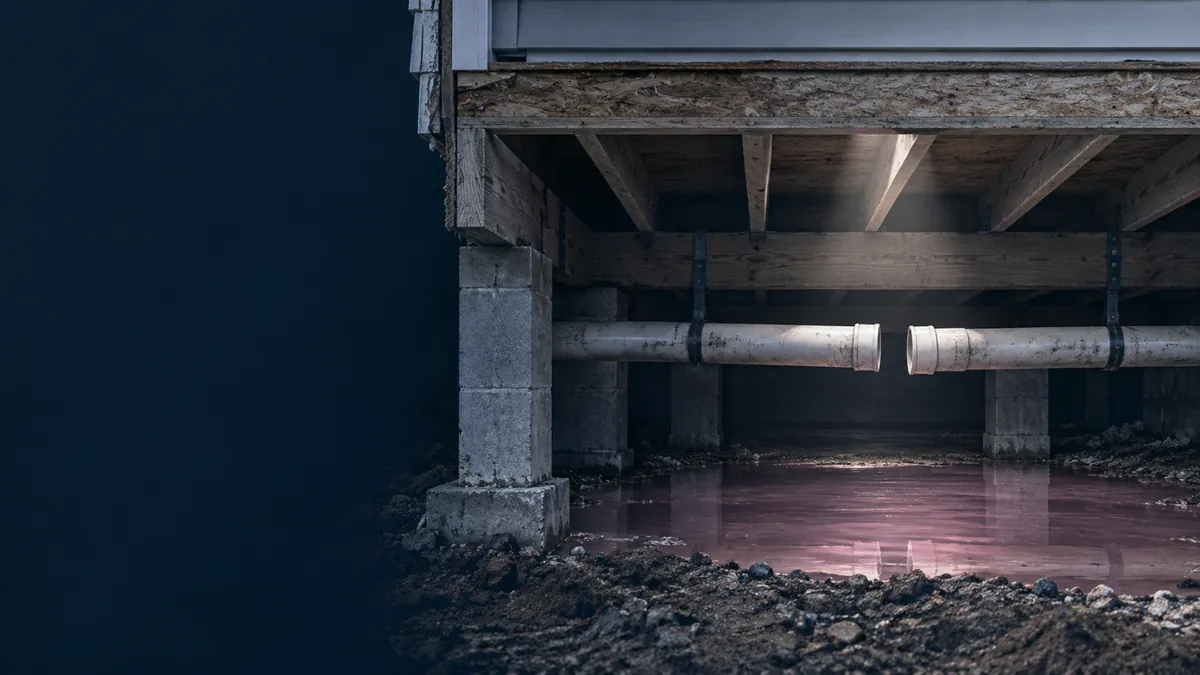
Here's a Georgia claim that's playing out right now, and it's the clearest lesson in homeowners insurance I've seen all year.
A homeowner finds standing water in their crawlspace. They don't know where it's coming from. They do the right thing and file the claim first.
The carrier sends a representative out in late August. He goes under the house, takes photographs, inspects the space. He tells them the plumbing repair itself probably won't be covered, but the remediation more than likely will be.
The claim portal then shows three green lights: inspection complete, coverage determination complete, payment decision complete. Dwelling coverage listed as potentially applicable. An estimate generated the same day, for $0, because no work had been done yet.
The homeowner can't float tens of thousands of dollars. They relied on what they were told and authorized the remediation. Final bill: about $18,000.
Then the remediation crew pumps the water out and it substantially refills by the next day. They find the source. A PVC sanitary drain line in the crawlspace had come apart, and household wastewater was pouring straight out of it every time anyone ran a faucet or flushed.
Now a different representative is on the file saying it looks like this had been going on for weeks, and the claim is probably getting denied.
Why "sanitary drain line" matters more than it sounds
The type of pipe changes the coverage analysis.
On a standard HO-3, the covered peril is accidental discharge or overflow of water or steam from within a plumbing system, a heating or air conditioning system, a fire sprinkler, or a household appliance. Plenty of carrier forms word it "sudden and accidental." Check yours.
A disconnected drain line discharging wastewater is a discharge from within the plumbing system. That part generally fits.
Two wrinkles come with it. First, this is wastewater, which restoration professionals classify as Category 3, and the cleanup standard is higher and more expensive than clean water. That's part of why the number is $18,000 and not $4,000. Second, some carriers try to route drain line losses toward the water backup and sump overflow endorsement, which many people never bought. Backup is sewage pushing back up through a drain. A pipe that came apart and is discharging forward is a different event. If a carrier leans on backup language, that's worth pushing on.
And in every version of this, the policy pays to tear out and replace the building material to get at the failed pipe, but it does not pay to repair the pipe itself. The rep in this story got that part right.
The whole fight is about time
Look at the exclusion. Constant or repeated seepage or leakage of water over a period of weeks, months, or years.
Same water, same crawlspace, same $18,000. The only question is how long it was running.
Some carriers use a tighter version that excludes seepage over a period of 14 or more days. Courts that have looked at that specific wording have generally read it narrowly, against the carrier, so a leak of 13 days or less stays covered. If your form says "weeks, months, or years" instead, there's no day count to argue about, and the adjuster's read of the physical evidence is what decides it.
Which brings up the part of this story I'd be leaning on hardest.
The crawlspace was pumped dry and substantially refilled in roughly a day. That's a measured accumulation rate, and it's the best evidence in the file. If the space fills that fast, the volume they found does not require weeks to get there.
Rot depth, staining lines, mineral trails on the pipe, and mold colonization all still speak to duration, so the refill rate settles nothing on its own. What it does is force the carrier to support "it looks like weeks" with something.
An adjuster's visual impression is an opinion. When a carrier applies an exclusion, the burden of proving the exclusion applies generally sits with the carrier, and a serious duration finding usually comes from an engineer or a cause-and-origin report, not from a walkthrough.
What Georgia law actually does with a verbal "probably covered"
Here's the honest answer, which is not the one most homeowners are hoping for.
Georgia follows the general rule that waiver and estoppel cannot create coverage that the policy doesn't provide. If a loss is genuinely excluded, an adjuster telling you it looked covered usually does not transform it into a covered loss. There are exceptions in Georgia around an insurer defending a liability claim without reserving its rights, but that's a different situation from a first-party property claim like this one.
So relying on the phone call is a weaker position than it feels like. That's exactly why the written coverage position matters so much, and why I'd never tell a client to spend $18,000 on a verbal maybe.
What Georgia does give you, if the loss turns out to be covered: O.C.G.A. Section 33-4-6. If a covered loss goes unpaid for 60 days after a proper demand, and a court finds the refusal was in bad faith, the insurer can owe the loss plus a penalty of up to 50% of its liability or $5,000, whichever is greater, plus reasonable attorney's fees. Note the order of operations. Bad faith requires a covered loss first. It's not a remedy for being told the wrong thing.
I'm an insurance agent, not an attorney. On a five-figure claim headed toward denial, a Georgia first-party property attorney is worth the consultation, and most of them will look at a file like this for free.
What to demand in writing, before the decision comes
If you're ever in this seat, ask for all of this by email so there's a record.
- The formal coverage decision in writing, quoting the exact policy provision relied on and the specific factual basis for it.
- A complete copy of your policy including all endorsements.
- The complete claim file, the first representative's inspection report, and the photographs taken that day.
- Any engineer or cause-and-origin report, and the credentials of whoever authored it.
- A written explanation of how duration was determined.
Keep every portal screenshot. Keep the remediation invoices, the photographs of the disconnected pipe, and the video of water discharging from it. That video proves the mechanism, and it's the one piece nobody can argue with.
And if the handling itself was the problem, the Georgia Office of Commissioner of Insurance and Safety Fire takes consumer complaints. A complaint doesn't decide coverage, but it does put a regulator's file number on the claim.
The three rules this would have changed
Portal status lights are not coverage decisions
"Coverage determination complete" next to a $0 estimate is a workflow state in a software system. The estimate in this story even said outright that it was a current evaluation subject to revision. The only thing that counts is a written position from the adjuster assigned to your file, naming the provision they're relying on.
Document heavily, then mitigate, then stop
Your policy requires you to protect the property from further damage. Shut the water off, get fans and a dehumidifier going, pump the standing water out. It does not require you to authorize a full reconstruction before anyone has confirmed coverage in writing. Stabilize and wait.
Keep the failed component
That section of pipe is physical evidence of the mechanism and, sometimes, of the timeline. Bag it. Don't let the plumber haul it off.
While you're in there, check your mold cap
Most Georgia homeowners forms carry a sublimit on fungi and mold remediation. Commonly $5,000 or $10,000, and some forms sit as low as $1,000. It caps the whole remediation, not each item, and crawlspace jobs blow past it fast. Buy-ups to $25,000 or $50,000 exist and are usually cheap. Look at your declarations page and find the line.
The unglamorous prevention part
Go under your house twice a year, or pay somebody $150 to do it. You're looking for standing water, a wet spot on the vapor barrier, growth on the framing, and any pipe with a mineral trail running down it.
A drain line found disconnected in March is a plumber's afternoon. The same line found in November is a denied claim, a rotted floor system, and a Category 3 cleanup. The difference between those outcomes is one flashlight and 20 minutes.
Send me the dec page
I run a free Claim Ready Coverage Check. Send me the declarations page of whatever you have right now and I'll read every line of it, then send back a one-page breakdown: your actual water language, whether you carry water backup, what your mold cap is, and where you're exposed.
No quote required. If your current policy is solid, I'll tell you that and you can go about your day.
Email it to michael@ins.insure. Licensed in Georgia, Alabama, Tennessee, Ohio, Arkansas, and Texas.